Thursday, July 30, 2020

Beaches, pilgrim, lion tourism circuit to be developed in Saurashtra

 
Thu, Jul 16 2020 07:29:48 PM

Gandhinagar, Jul 16 (IANS): The Gujarat government on Thursday announced it is planning a tourism circuit involving Saurashtra's beaches, pilgrim places and lions.

Gujarat Chief Minister Vijay Rupani launched projects worth Rs 126.96 crore regarding pilgrim places in Gujarat from Gandhinagar online.

Rupani said that, "The Gujarat government is mulling developing a tourist circuit involving pilgrim places, beaches in Saurashtra and the pride of Gujarat, lions of Gir forest and chalk out a circuit surrounding all these places. Pilgrim places like Jyotirling Somnath and Girnar hill, historical places like Uparkot, the beaches of Somnath and lion sighting in Gir Lion Sanctuary in Saurashtra."

He said that, "The Gujarat government is resolved to make Gujarat a world tourist destination state by development of various tourist centres in the state."

"The ropeway in Girnar which will begin shortly in the coming days will be a new major attraction for tourism in the state," added Rupani.

Rs 45 crore worth of developmental works was carried out at the Somnath temple in Veraval. Union Minister of state for tourism, Prahladsinh Patel was also present for the launch through video link.

"The state government is actively working on developing world class facilities like large parking space, community kitchen, Tourism Information Center, Somnath Museum at the Somnath trust temple. Gujarat is emerging as a new force in economic growth by providing more jobs in service sectors like tourism," added Rupani.

Public dedication of many other pilgrim places was also carried out during the e-launch.
https://www.daijiworld.com/news/newsDisplay.aspx?newsID=731112


More than Rs 25 crore for Asiatic lions unspent despite 331 deaths

Positions of forest guards, veterinarians and foresters are lying vacant and a vaccine is yet to be developed
By Ishan Kukreti Last Updated: Monday 13 July 2020

The Gujarat government has not spent Rs 26 crore since 2018-19 that was meant for the conservation of the endangered Asiatic lion in the state’s Asiatic Lion Landscape (ALL), despite 331 leonine deaths in 2018-19.

The figures were shared by the Gujarat forest department with a committee created by the Union Ministry of Environment, Forest and Climate Change (MoEF&CC) on May 29, 2020 to look into the high mortality rate of Asiatic lions in ALL.

Since 2018-19, Rs 38 crore (Rs 17 crore in 2018-19 and Rs 21 crore in 2019-20) was sanctioned as the Centre’s contribution for the Asiatic Lion Conservation Project under the Centrally Sponsored Scheme for Development of Wildlife Habitat.

But the state government has utilised only Rs 7 crore (Rs 61 lakh in 2018-19 and Rs 6 crore in 2019-20). In 2018-19, the unspent amount stood at Rs 16 crore and the same stood at Rs 9 crore in 2019-20.

While the state government hasn’t utilised the money, it has also not filled vacant positions. Of the 681 sanctioned positions of forest guards in the Junagadh Wildlife Circle and Gir (East) Division, only 360 positions, or barely a little over half, have been filled. Similarly, in the two forest administrative units, of the 250 sanctioned positions of foresters, only 138 have been employed.   

After the 2018 Canine Distemper Virus (CDV) outbreak, 20 positions of veterinary doctors were sanctioned by the government. But they are lying vacant as recruitment hasn’t taken place.

The state government has not been able to create a vaccine yet. The GBRC has done the Sero prevalence of Canine Distemper Virus in Asiatic Lions of Gir, Gujarat study and has been asked to develop a CDV vaccine.

“In the year 2018, 1,300 doses of purevax ferret distemper vaccine (Merial, USA) were procured. Of them, 1,100 were utilised for active immunization of the lion population. However, procurement of another 1,000 doses of this vaccine is in process,” the committee report said.

Eighty-five lions have died in ALL between January and May 2020, according to the report — accessed by Down to Earth — submitted by the committee appointed by the MoEF&CC to the ministry and the Prime Minister’s Office in the first week of June. In 2018 and 2019, a total of 112 and 134 lions died in ALL, the report said.

Of the 85 lions that died in early 2020, almost half (44) died due to diseases. The Gujarat forest department has sent blood and swab samples of 48 lions and six tissue samples for investigation and diagnosis to the Gujarat Biotechnology Research Centre (GBRC) in Gandhinagar on May 8. The results are awaited.

Committee recommendations

  • Fill the 20 sanctioned positions of veterinary doctors on a priority basis.
  • Mandatory consultation with experts from national institutions like Indian Veterinary Research Institute, Izatnagar, Wildlife Institute of India, Dehradun, etc and send samples from diseased animals to more than one national accredited lab to screen all infectious and contagious diseases.
  • Report lion mortality in ALL to MoEF&CC on a daily basis.
  • Constitute a team comprising of an immunologist, epidemiologist, virologist, parasitologist, clinical expert and ecologist for field visits to ascertain the actual cause of mortality.
  • Develop a clear standard operating procedure by taking help of national institutes in coordination with MoEF&CC for disease control.
  • Expedite the development of CDV vaccines.
    https://www.downtoearth.org.in/news/wildlife-biodiversity/more-than-rs-25-crore-for-asiatic-lions-unspent-despite-331-deaths-72266

View from India: Country’s tiger count makes it to Guinness World Records

The official website of Guinness World Records states that every four years since 2006, a nationwide assessment of India’s population and habitat of tigers is conducted. This exercise is executed by the Indian government’s National Tiger Conservation Authority and the Wildlife Institute of India in collaboration with the state forest departments and conservation NGOs. The 2018-19 survey, which is the fourth iteration, has been the most comprehensive to date in terms of both resource and compilation of data.

What makes this survey noteworthy is the clever usage of camera traps, which has given a precise edge to the process of counting tigers. The camera traps are outdoor photographic devices fitted with motion sensors that start recording when an animal passes by. They have been placed in 26,838 locations across 141 different sites and have surveyed an area of 121,337 square kilometres (46,848 square miles).

In total, the camera traps have captured almost 35 million photographs of wildlife. Of these, 76,651 are tigers, 51,777 are leopards, and the remaining ones are the native fauna. From these photographs, 2,461 individual tigers (excluding cubs) have been identified through stripe-pattern-recognition software.

A three-phased assessment, statistical computation of various datasets has led to the final results of the report. There’s scope to scale up the tiger count by improving ‘corridors’ between the isolated pockets of tiger territory. It’s important to restore the habitat of the majestic striped animal and save it from poaching; its community needs to be conserved and expanded.

“The All India Tiger Estimation is now in the Guinness World Records for being the largest camera-trap wildlife survey, a great moment indeed and a shining example of Aatmanirbhar Bharat,” tweeted Prakash Javadekar, Union Minister for Environment, Forest and Climate Change.

Statistics from International Tiger Day 2019 revealed that India is home to 75 per cent of the world’s tiger population. With 2,967 tigers, the country had strengthened its foothold as one of the world’s largest and safest tiger habitats.

Meanwhile the lion, the king of the jungle, made news last month. The Gir National Park in Gujarat has seen an increase in the number of Asiatic lions over the last five years.

The lion census, which happens every five years, was supposed to be conducted this year but the coronavirus pandemic forced authorities into taking a different approach.

Officials from the Gujarat Forest Department conducted a population estimation exercise on the full-moon nights of 5 and 6 June. The growing numbers of the Asiatic lion can be attributed to a number of factors including community participation and wildlife healthcare. There’s also emphasis on technology, as well as habitat management; measures to minimise human-lion conflict have also been taken.

The Gir National Park is the world’s only habitat for Asiatic Lions. Their population has expanded from 523 in 2015 to 674 in 2020, registering an increased growth rate of 28.87 per cent (one of the highest growth rates so far following 27 per cent growth in 2015). 

The distribution of the lions has gone up from an area of 22,000 square kilometres in 2015 to 30,000 square kilometres in 2020, which has led to an increase in the distribution area of 36 per cent.

Modi expressed his happiness and tweeted: “Two very good news: Population of the majestic Asiatic Lion, living in Gujarat’s Gir Forest, is up by almost 29%. Geographically, distribution area is up by 36%.”

Let’s hope that the tigers and lions, the Alpha predators of the jungle, are preserved and protected and that their tribe grows.
https://eandt.theiet.org/content/articles/2020/07/view-from-india-country-s-tiger-count-makes-it-to-guinness-world-records/

Monday, July 27, 2020

The Gujarat model

Monday, 27 July 2020
A second home for the king of beasts

At a time when India and the world are battling both a pandemic and an economic slowdown, there is a thirst for news that uplifts the spirit. What could be better timed than the results of the latest headcount of Asia’s last and only population of lions? The news is doubly positive: not only are there more lions in the Saurashtra peninsula, Gujarat, since the estimates began but their range has also expanded manifold. 

The lion’s roar may be muffled across many African countries where it is under major pressures outside parks, reserves and community grazing lands. The news from India, from Gujarat in particular, gives room for hope. But it is tinged with serious concern. Lion numbers and range are up but to have ‘all eggs in one basket’, as the proverb goes, makes little sense. 

One outbreak and many lions may be lost. Yet, the deaths of lions due to canine distemper, although admitted by the forest department, are not leading to a rethink of the stance of the state government against a second home. In times when humans have grappled with not one but many epidemics that spread rapidly — AIDS and Ebola, Nipah and now Covid-19 — the urgency of a secure second population hardly needs to be newly emphasized.

It turns out, based on the pathbreaking work by Stephen O’Brien (written about in his remarkable book, Tears of the Cheetah), that the lions of Gir are especially vulnerable. DNA mapping shows they have been inbred not once but twice. Much of Kathiawar was an island 2,000 years ago; all the big cats are descendants of those animals. Big game hunting and local killing did bring down numbers again around 1900 to ‘a few dozen’. So, this is a large, growing number but all are descendants of survivors of two bottlenecks. 

Since the early 1990s, and after much research, Kuno in Madhya Pradesh was selected and a park established. A previous such attempt at finding a second home had failed. Lions were taken to Chandraprabha sanctuary, Uttar Pradesh, in 1956. They bred and dispersed. Many were poisoned and some shot. Preparation was poor and protection non-existent.

Kuno is a case in contrast. Nestled in a larger forest tract of over 3,000 sq km, twice the size of the Gir sanctuary, is an area readied for lions to be moved. Surveys by the Wildlife Institute of India show a high density of prey. Chital and wild boar and sambhar are all potential meal for a hungry big cat. The density of the sambhar and nilgai are higher than in the lion’s native Gir Forest. 

In 2013, the Supreme Court cleared the way for moving a few lions. This point needs emphasis as the hurdles to the idea of relocation are cultural and political rather than scientific.

To know why we need to go back a step in time.

In 1972, the lion as symbol both lost and gained. It ceased to be the national animal of India. The tiger was made the national animal as it was seen to be an emblem of ‘unity in diversity’. Unlike the 19th century when lions had ranged across north and central India, they are found only in one state: Gujarat. But the latter acted around the same time and declared it a state animal.

Lions have been symbols of power and authority for centuries. No wonder independent India gave Ashoka’s lion capital from 2,300 years ago such a prominent place. But in the early 1970s, it became an icon of regional pride and a rallying point for fresh conservation efforts. The federal and state governments joined forces to launch the Gir Lion Sanctuary project a year before the more famous Project Tiger.

Gir’s lions had declined in numbers and were often in sharp conflict with livestock owners. A part of the forest became a national park with no timber operations or gazing. Some Maldhari settlements were also moved out. By the end of the 1980s, the lions in the sanctuary shifted their diet from domestic to wild prey. 

Since then, successive estimates have shown their numbers as well as their range are growing. There are debates about the methods of estimation. Still, there is little doubt of there being far more lions than in the past. The last quarter-century has seen a sharp fall in the range and in the numbers of Africa’s lions. 

But the work done in and around Gir is a study in contrast. Gujarat can justifiably take much credit for the turnaround. The state government gave up timber revenues from the national park and funded the resettlement of the pastoralists. Even further, when lions were poached in 2007 for their claws, a direct recruitment of watchers from the nearby villages ensured there was no repetition. The payment of compensation for cattle kills has also helped alleviate loss of entitlement of the stock owners.

This cannot obscure a home truth. None of this conservation success reduces the threat. The danger of an outbreak of disease is all too real. Gir’s lions are inbred. 

The Gir lions show a lower range of genetic diversity than some of Africa’s most inbred wild populations. The 100 odd lions of Tanzania’s Ngorongoro Crater saw high mortality in 1962 when a blood-sucker fly led to the death of all but reportedly 10 animals. Since then the population has been inbred. Asia’s last lions are even less diverse in genetic terms than them.

But regional nationalism has made the animals a symbol of Gujarati asmita

In 1997, the then chief minister, Shankarsinh Vaghela, made moving the lions into a prestige issue. Speaking in Rajkot, he said “not a single lion cub” would ever leave the state. The lion was also a symbol of his short-lived regional party. But this attitude has many more adherents than he did. 

The result is that no serious dialogue is possible with the state government on the matter. The lions are now Gujarat’s first and last. This is not logical. For Gujarat and Gir will always be the first home of Asia’s lions. This can reconcile regional and all-India concerns rather than pit them against one another. The majestic creature has resonance across languages and cultures across the land. It is only recently that it has become largely, if not solely, a regional icon.

A second home will be an insurance against calamity. Half a century ago, timely steps helped secure the lions in Gir. It is time to go one step further. Tomorrow may be too late.

The writer is a professor of history and environmental studies at Ashoka University

https://www.telegraphindia.com/opinion/the-gujarat-model-a-second-home-for-lions-the-king-of-beasts/cid/1786134


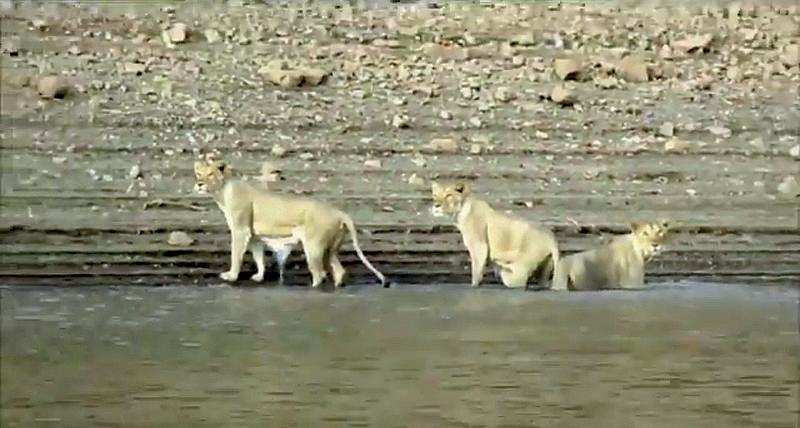
Gujarat: Video of lionesses crossing river goes viral

RAJKOT: An old proverb says cats (read lions) and water don't mix, but if they would have seen this video, the wise men’s words would have surely met its waterloo!
For, the agility shown by three lioness while swimming almost 200 metres across the Shetrunji River near Rawal Dam in Gir East, would stun many into disbelief that even the royal feline can get more than its feet wet. A video of this incident has gone viral on the social media.

Anshuman Sharma, deputy conservator of forest, Gir East, who shared the video on WhatsApp and social media, said: “It is a myth that the lions can’t swim. This video clearly breaks this myth and shows how the lions love to swim. This video was shot by beat guard R S Sarla.”


“The lionesses apparently crossed the river to prey on deer,” added Sharma.

https://timesofindia.indiatimes.com/city/rajkot/video-of-lionesses-crossing-river-goes-viral/articleshow/76929251.cms

Rome zoo shows off two lion cubs born under lockdown

July 10, 2020 / 7:02 PM / 17 days ago

ROME (Reuters) - A Rome zoo showed off two lions cubs on Friday, both born during the city’s long coronavirus lockdown.

Staff said the sisters were the first Asiatic lions born at Bioparco zoo since it started keeping the endangered species 22 years ago.

“A true symbol of hope and resurgence,” Rome’s mayor Virginia Raggi said as she welcomed the news.

Seven-year-old mother Sajani and four-year-old father Ravi looked on as the cubs posed for pictures. At one point they had a play fight with their mother’s tail before she whisked it away.

The zoo said it was planning to launch a social media campaign to ask people to name the cubs.

Sajani gave birth on April 29, her own birthday.

“We saw just two days before that she was behaving kind of strange, and we suspected she was pregnant,” keeper Yitzhak Yadid said.

Staff only knew for sure the cubs had survived when they heard small yelps coming from Sajani’s enclosure

“Not all mothers can succeed usually the first time that they give birth. She’s a very, very good mother,” Yadid said.

Reporting by Antonio Denti and Emily Roe; Writing by Angelo Amante; Editing by Andrew Heavens

https://in.reuters.com/article/italy-lioncubs/rome-zoo-shows-off-two-lion-cubs-born-under-lockdown-idINKBN24B1V6

Bharathiya Reserve Bank Note Mudran (P) Ltd pays Rs 10 lakh to adopt animals in Zoo for one year

http://www.uniindia.com/bharathiya-reserve-bank-note-mudran-p-ltd-pays-rs-10-lakh-to-adopt-animals-in-zoo-for-one-year/south/news/2072710.html

HC grants bail to man held for filming Asiatic lions

TNN | Jul 9, 2020, 04:00 IST

Ahmedabad: The Gujarat high court has granted conditional bail to one of the accused persons involved in videography of Asiatic lions in the Veraval forest range in January this year.
The person released on bail was Hala Naeem Mohmad Soyab, a resident of Veraval. He was the third person who has got bail in this incident of filming the lions on January 22. The forest department booked him along with two others under Sections 2(16), 2(17), 2(20), 2(31), 2(36), 2(37), 9, 39, 50, 51 and 52 of the Wildlife Protection Act, 1972, for causing disturbance to wild animals, chasing them in a vehicle and filming them.
A sessions court in Veraval had denied bail to Soyab, which compelled him to approached the high court last month. He submitted that he was innocent and that the lions had strayed into the revenue area and filming them in revenue areas cannot be an offence. He was not involved in any hunting activity and it was not such a serious offence.
On Monday, Justice A C Joshi ordered to release Soyab on bail on his furnishing Rs 15,000 bail bond and by imposing various other conditions including surrendering his passport.

Meanwhile, another person, Ilyas Hoth, who was arrested on charges of teasing a lioness during an illegal lion show, has not been granted bail by the high court even a year after his arrest. The viral footage of the lion show had created a controversy last year.

https://timesofindia.indiatimes.com/city/ahmedabad/hc-grants-bail-to-man-held-for-filming-asiatic-lions/articleshow/76862625.cms