Thursday, May 30, 2019

Return To Motherland: Asiatic lion returns to Iran after 80 years

Report by Tehran Times; photos by Hamid Amlashi, ISNA
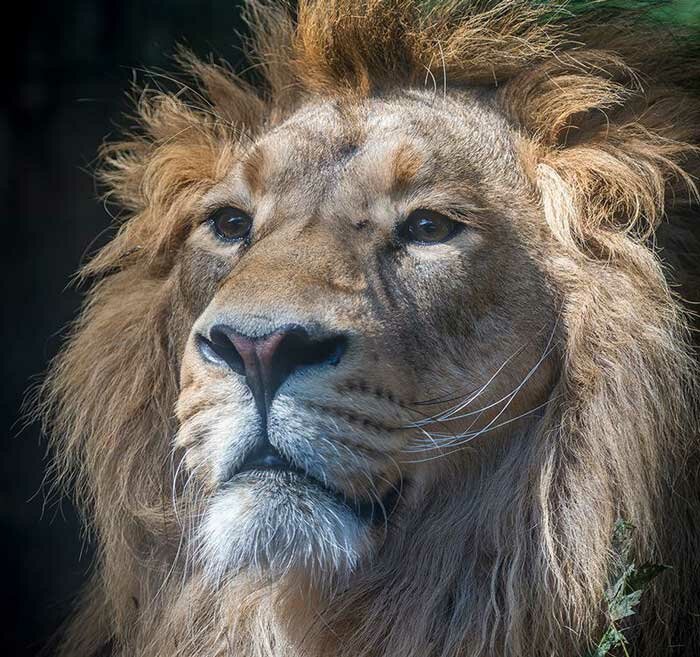
TEHRAN - Tehran Zoological Garden, also known as Eram Zoo, will be home to Asiatic lion, which was extinct in the country for almost 80 years, a veterinarian at Eram Zoo has said.

Asiatic Lion at Eram Zoo in Tehran
According to Iman Memarian the last remaining Asiatic lion was sighted about 80 years ago in Iran. He went on to explain that before and after the Islamic Revolution (1979) Iran made attempts to bring back Asiatic lion to Iran, but Indians did not cooperate.

Tehran Zoological Garden has put in efforts to bring back Asiatic lion to Iran for 6 years, he said, adding that, "we submitted our request to the European Association of Zoos and Aquaria (EAZA)."

"We also developed a lion pen which complied with EAZA's standards," Memarian highlighted.

Asiatic Lion at Eram Zoo in Tehran
According to the National Geographic nearly all wild lions live in sub-Saharan Africa, but one small population of Asiatic lions exists in India's Gir Forest. Asiatic lions and African lions are subspecies of the same species.

European Endangered Species Programme (EEP) recommended that a male and a female lions will be brought to Iran, however, U.S sanctions against Iran has complicated the transfer.

And now after years of collective attempts on Wednesday morning Tehran Zoological Garden will celebrate the return of the Asiatic lion to the country, Memarian concluded.

Asiatic Lion at Eram Zoo in Tehran
Asiatic lions once prowled from the Middle East to India. Now, only a fraction of these magnificent animals survive in the wild. Its range is restricted to the Gir National Park and environs in the Indian state of Gujarat. The Gir Forest's dry teak woods were once a royal hunting ground. Today they are a reserve where these at-risk big cats are heavily protected.

On the International Union for Conservation of Nature (IUCN) Red List, it is listed under its former scientific name Panthera leo persica as Endangered because of its small population size and area of occupancy. It was also known as "Indian lion" and "Persian lion".

Until the 19th century, it occurred in eastern Turkey, Iran, Mesopotamia, and from east of the Indus River to Bengal and Narmada River in Central India. Since the turn of the 20th century, it is restricted to the Gir Forest National Park and surrounding areas.

Historical records in Iran indicate that it ranged from the Khuzestan Plain to the Fars in steppe vegetation and pistachio-almond woodlands. It was widespread in the country, but in the 1870s, it was sighted only on the western slopes of the Zagros Mountains, and in the forest regions south of Shiraz. Some of the country's last lions were sighted in 1941 between Shiraz and Jahrom in Fars province, and in 1942, a lion was spotted about 65 km northwest of Dezful. In 1944, the corpse of a lioness was found on the banks of Karun River in Khuzestan province.

Conflicts with humans, wildfires, poaching, canine distemper virus, decreases in population sizes of native ungulates are of the threats to the lions.
http://www.payvand.com/news/19/may/1005.html

Lioness found dead in Gujarat's Gir forest


Press Trust of India  |  Ahmedabad 
A lioness was found dead in range of forest in Gujarat, an said on Friday.
The carcass of the lioness, around two years of age, was found Thursday evening near a small river in range of Gir-East division, an said.
Primary investigation has revealed the lioness was killed in a territorial fight among the big cats to establish dominance in the area, said Chief of Forests (Wildlife) Junagadh, D T
"We found canine teeth and nail injury marks on the animal's body, which suggest the lioness died in a territorial fight between big cats," said Vasavada, adding the carcass has been sent for post mortem.
Since February this year, four cubs, two lions and one lioness have been found dead in the forest.
Gujarat, the last abode of Asiatic lions, as per a latest estimate by the Forest department, is home to around 600 lions in and surrounding areas.
(This story has not been edited by Business Standard staff and is auto-generated from a syndicated feed.)
https://www.business-standard.com/article/pti-stories/lioness-found-dead-in-gujarat-s-gir-forest-119050301214_1.html

Byculla zoo gets leopard, jackal pairs

Two-year-old male leopard named Drogone.
 Two-year-old male leopard named Drogone.
THE ASIAN AGE. | SONALI TELANG
Published : May 5, 2019, 5:49 am IST
Updated : May 5, 2019, 5:49 am IST

The most awaited Asiatic Lion is also expected to make an entry by April.
Mumbai: In a new addition to the Byculla Zoo, the most awaited big cat, a leopard has been brought to the premises.
A male and female leopard has been brought to the city zoo from Pilikula Zoo in Mangalore. These animals were added as a part of zoo renovation undertaken by the Brihanmumbai Municipal Corporation (BMC).
The male leopard is two-year-old and named Drogone while the female named Pinto is three-year-old. The leopards have been placed at the quarantine centre of the zoo at present. They will be shifted to their enclosures by April. The enclosures will have a feeding area and a perching place. Visitors can watch them in their full glory from June.
“The enclosure for the leopards is being prepared, the work will be completed by April. The leopards are being fed as per the recommendations provided by the earlier zoo. Our staff has been continuously monitoring their health,” said Dr Sanjay Tripathi, director of Byculla Zoo. The leopards are being fed buffalo meat and chicken, he said.
The zoo had previously hosted leopards but they died due to natural causes. Apart from the leopards, Byculla zoo has also brought in a pair of jackal as well as two of Indian peacocks.
The most awaited Asiatic Lion is also expected to make an entry by April.
“The proposal is yet to be approved by the central government. We are hoping that it will be done within a month,” added Mr Tripathi.
The Byculla zoo is currently undergoing renovation. The enclosures for tigers, lions, sambars, nilgai, swamp deer, hyenas among others are being prepared. The construction of aviaries and reptile house is also under construction, according to the zoo officials.
https://www.asianage.com/metros/mumbai/050519/byculla-zoo-gets-leopard-jackal-pairs.html

523 lions and one voter live in Gir forest. This is how he casts his ballot

 
By Annalisa Merelli in Banej, Gujarat
There are lions in India. At least 523 of them, according to the 2015 census, though unofficial counts put the number north of 600.
Unlike their more glamorous tiger cousins, who live across the country in natural reserves, the Asiatic lions are all concentrated in one location: Gir forest, a large savannah-like setting in the Junagadh district of Gujarat. They live there, protected by wildlife laws and hopefully multiplying, with hundreds of leopards—which are far more ferocious, and dangerous to humans—and a much rarer species: A lone specimen of Indian election voter.
Annalisa Merelli for Quartz
A female Asiatic lion in Gir forest.
With the exception of monsoon season, the Gir landscape would be more akin to a desert, if it weren’t for the plants that somehow grow here. The trees that emerge from the powdery ground are mostly bare, precariously holding onto a few dusty leaves, their trunks and branches bent in knotty shapes. They can be so light in color that they look like sculpted marble.
Annalisa Merelli for Quartz
Peacocks don’t do camouflage.
Temperatures reach above 110°F (43°C), and it does not rain for months, turning everything the color of sand. Indigenous lions, leopards, deer, jackals, and blackbucks have an easy time blending into the camouflage. Carelessly vain, only the peacocks stand out, like mirages amid the monotony.
Nested 35 km (about 22 miles) inside the forest, more than a two-hour drive through very bumpy roads and relatively far from where the lions like to spend their time, stands Banej. By a small stream from which emerge the bulging eyes of crocodiles, a modest temple is dedicated to Lord Shiva. It is the home of Guru Baharatdas Darshandas, a 68-year-old monk originally from Pali, Rajastan, who acts as its caretaker.
Darshandas lives there, and can usually be found sitting in a room decorated by old photographs (including one of his meeting with Narendra Modi in a nearby location) and religious paraphernalia, all washed out by the harsh Gujarati sun. He is not lonely. The universal rule of religious pilgrimages applies here: No matter how remote a holy place may be, busloads of devotees will show up. About 100 per day do so, according to Anil Solanki, the forest patrol officer for the area,. The numbers grow to more than over 1,000 for festivals.
https://qz.com/india/1607559/how-the-lone-voter-in-indias-gir-forest-casts-his-ballot/
Annalisa Merelli for Quartz
Guru Baharatdas Darshandas sits in his room in Banej; details from the wall.
Every election cycle since Dashandas moved to Banej, there is a very different pilgrimage to Banej—one that ends just a few hundred meters from the temple. It’s a mission to perform the fundamental ritual for the secular deity of democracy. For two days, a team turns the local forest department building into a polling booth, for the law demands that every citizen of India be given a voting location within two kilometers of their home. The booth cannot be set up in a religious or private building.
Annalisa Merelli for Quartz
The Shiva temple in Banej.
Darshandas votes every time. The Banej polling place, which falls under the Junagadh constituency, has a 100% turnout.

Fearless dog shows a lioness who's the boss | Watch

The video is said to be shot at the Gir Forest National Park in Gujrat, where an Asiatic lioness was hunting for her meal. She locks her target on a stray dog -- at a few metre distance.

Nirnay Kapoor
New Delhi Updated on: May 05, 2019 12:27 IST
An interesting video has surfaced on the internet where a dog can be seen fighting with a lioness to save its life. 
The video is said to be shot at the Gir Forest National Park in Gujarat, where an Asiatic lioness was hunting for her meal. She locks her target on a stray dog -- at a few meters away. 
Related Stories

The lioness runs towards the dog and tries to grab its neck with her jaws and claws. The brave dog confronts the carnivores and a one-on-one battle goes on between the two for a few seconds.
But the result was not as if on cue. The small and pity dog gives a tough battle to the lioness and succeeds in saving its life. Later, the lioness falls silent and leaves.
The whole incident was captured by the residents on the mobile camera.
This remarkable footage epitomizes the strength of will power. Not giving up and fighting its best saved the brave dog of becoming the deadly carnivores' feast.
The Gir Forest of Gujarat, is a wildlife reserve for Asiatic lions. It was established to protect the lions. 
https://www.indiatvnews.com/news/india-fearless-dog-shows-a-lioness-who-s-the-boss-watch-518139

Will recently returned Persian lion survive threats once pushed it toward extinction?

May 5, 2019
TEHRAN – Long-lost Persian lion is back to the country to conserve the rare species by reproduction, the species which once gone extinct due to excessive hunting and habitat loss, so the question arises, will the endangered species survive the threats which once pushed it through eradication?
Disappeared for 80 years, Persian lion once prowled from the Middle East to India, while currently only a fraction of these magnificent animals survive in the wild, which range is restricted to the Gir National Park and environs in the Indian state of Gujarat. 
On the International Union for Conservation of Nature Red List, it is listed under its former scientific name Panthera leo persica as Endangered because of its small population size and area of occupancy. 
Conflicts with humans, wildfires, poaching, habitat loss, canine distemper virus, decreases in population sizes of native ungulates were among the threats pushed the lions toward extinction in Iran, while lack of protection measures and plans is not deniable either.
A male Persian lion, born 6 years ago, was sent to Tehran Zoological Garden from Britain’s Bristol Zoo a week ago, under a population management program aiming at endangered species reproduction by the European Association of Zoos and Aquaria (EAZA).
Under the program, European Endangered Species Programme recommended that a lion couple to be brought to Iran in order to conserve and recover the species once again in their original habitat employing disease control measures.
Iran will soon host a female lion of the same subspecies from Ireland to accompany the recently returned male lion through the conservation program.
However, questions come up that will the world's last ranging population of Persian lion raises hope for the species conservation? Does it ensure a stable lion population in the country?
First attempts to bring back the precious species
In the Iranian calendar year 1350 (March 1971-March 1971), Iran made attempts to bring back Asiatic lion to Iran, under an international project aiming to revive the country’s natural habitats, but it faced Indians opposition.
The project was called Arzhan due to the fact that lions once ranged in Dasht-e Arzhan, to Parishan Lake both located in Fars province.
Under the project, Iran was supposed to send 4 Asiatic cheetahs to the India and receive 12-16 Asiatic lions in return.
Hooshang Ziaei, an environmental expert, told Khabaronline that we made great efforts for the project which mainly focused on rehabilitation of habitats.
In this regard, we bought some of the rainforests in proper areas and enhanced the population of wild boar, gazelle and ovis orientalis in these areas, he said, adding, then we increased the population of Persian fallow deer, so that the lion’s habitat was prepared.
However, India did not cooperate and the project left unattended, he regretted, adding, the area’s environment also bearded severe damages that led Parishan lake to be dried up.
No concern rises toward the species habitat
This is while, some of the past experiences have caused some environmentalists to be concerned about the Persian lion's future in Tehran Zoological Garden, as in the Iranian calendar year 1389 (March 2010-March 2011), 14 lions died in the Zoo due to an outbreak of glanders (an infectious disease occurs primarily by ingestion of contaminated food or water), which is mainly related to not meeting the standards.
Mohammad Reza Parhizkar, head of Tehran Zoological Garden, told Khabaronline that “we put in efforts to bring back Asiatic lion for 6 years, so it can be a new beginning for the species to live in its motherland once again.”
He went on to note that I believe that it was a positive attempt to help the generation of the species and revive the country's wildlife.
Lions are returned to the country due to the membership of the Tehran Zoo in EAZA, and the organization never allows the wildlife species to transfer to a zoo not meeting the internationally defined standards, Parhizkar also added.
Pointing to the traumatic event, he said that the condition is improved compared to 8 years ago, the Zoo is living up to the required standards, and take safety measure strictly to prevent such happenings.
So there is no concern about the condition and the place where the animal is being kept, he said, adding that of course, there are still several steps to be taken to conserve Persian lion in the country, perhaps many measures needed to be carried out in this regard.
Referring to the lion couple’s future habitat, he noted that Dez forests, in Dezful county located in Khuzestan province, seems to be a proper habitat for the lions due to the presence of fallow deer species, with fencing the roads taken into consideration.
Although, several studies must be carried out to determine their natural habitat precisely, he said, highlighting that if the studies demonstrate negative consequences, reproduction of the species in the country will be avoided even through captive breeding in the zoos.
Asiatic lions range years ago
Until the 19th century, it occurred in eastern Turkey, Iran, Mesopotamia, and from east of the Indus River to Bengal and Narmada River in Central India. Since the turn of the 20th century, it is restricted to the Indian Gir Forest National Park and surrounding areas.
Historical records in Iran indicate that the Asiatic lion ranged from the Khuzestan Plain to the Fars in steppe vegetation and pistachio-almond woodlands. It was widespread in the country, but in the 1870s, it was sighted only on the western slopes of the Zagros Mountains, and in the forest regions south of Shiraz. 
Some of the country's last lions were sighted in 1941 between Shiraz and Jahrom in Fars province, and in 1942, a lion was spotted about 65 km northwest of Dezful. In 1944, the corpse of a lioness was found on the banks of Karun River in Khuzestan province.
Persian lion to remain in Iran
Although, current weather and other conditions in the country seems appropriate to bring the invaluable species back to the motherland again, protection plans must be drawn up defining the related issues along with taking necessary measures to prevent the species from facing the threats resulted in their eradication before.
Studies on recognizing the favorable habitat for the lions, enhancing the protected areas as well as the rangers, increasing the species’ prey, highlighting the role of NGOs on reintroducing this species, making people acquainted with the endangered species and training the locals to know the value of the Persian lion and prevent any illegal capturing of the animal are among the solutions to ensure a stable lion population in the country.
FB/MG
https://www.tehrantimes.com/news/435467/Will-recently-returned-Persian-lion-survive-threats-once-pushed

Monday, April 29, 2019

Big cats of Gir facing a big problem: 26 lions and 5 cubs might never be released back into the wild


Wildlife experts say not just cubs, but adult lions too may find it difficult to adapt to forest environment back again after such a prolonged stay in captivity.

The authorities have not yet set a date for the release of the captive lions and cubs in Gir. However, Chief Conservator of Forest D T Vasavada says the lions are healthy and doing well.

Principal Chief Conservator of Forest and Wildlife Warden A K Saxena told Mirror, “The lions have been vaccinated, so we need to follow a certain protocol before releasing them. They have to be kept under observation for long periods as medical teams need to check their immunity and analyse other effects of vaccines. Also, certain medical tests have to be carried out to check whether or not these big cats have started producing antibodies naturally.”

Cubs may have to remain captive for much longer, perhaps all life, as they have learnt to be fed artificially, Saxena added.

It all began six months ago when over 30 lions died in about 3 months’ time. In fact, over 23 of them died in just 20 days in September 2018 alone of suspected Canine Distemper Virus. Most of the deaths were reported from Dalkhaniya range of Gir (east). Following this, 31 lions were rescued from the affected area near Semerdi in Gir so as to avoid more casualties. In Semerdi, an alarming 11 lions had died in a span of three days.

The captured lions were housed at a veterinary facility in Devaliya. They were given vaccines at specific times over a duration in keeping with the protocol for such disease outbreaks.

HS Singh, retired Principal Chief Conservator of Forest and Chairman of Gujarat Biodiversity Board said, “Since these captive lions have interacted so much with humans during their treatment, it is not appropriate to release them in their habitat. We don’t know how they will behave in the wild.” With long periods of living near humans, the lions can lose fear of humans and approach them fearlessly in the wild, leading to higher incidence of animal-human conflict. On the other hand, these lions may also have lost the ability to hunt which could affBig cats of Gir facing a big problem: 26 lions and 5 cubs might never be released back into the wildect their survival.

Singh added, “Their territory may also have been taken over by other animals, which leaves them with more competition for food than earlier.” Currently, there are more than 700 lions in the Gir region; the numbers having grown at healthy rate in the last five years, with the highest density being in Brihad Gir and Gir east. They are now moving out to revenue areas and making new places their home.

The lions that got affected by the virus infection died of respiratory and hepatic failure. After the receipt of test reports from Pune-based Institute of Virology, the lions were rescued and given vaccine shots. Department had ordered 300 shots of vaccines from US for the lions in last six months. Recently the forest department ordered another big consignment of 400 shots of the vaccine. “We need to keep in a sufficient stock at all times,” said Saxena.


might never be released back into the wild

Read more at:
https://ahmedabadmirror.indiatimes.com/ahmedabad/cover-story/captive-pride/articleshow/69087664.cms?utm_source=contentofinterest&utm_medium=text&utm_campaign=cppst

Man bathing in Ambajal dam in Junagadh killed by crocodile

Junagadh, Apr 27 (UNI) A 50-year-old man was killed by a crocodile on Saturday while he was bathing in Ambajal dam in Visavadar area close to Gir forests in Junagadh district of Gujarat.

A forest official said that the deceased has been identified as Bhanubhai Hamirbhai Chudasama, resident of Upleta. He had come to meet his son Gudlabhai who cultivates vegetables in the catchment areas of the dam close to Manadia beat of west Gir forests.
UNI RAJ JW2258
http://www.uniindia.com/man-bathing-in-ambajal-dam-in-junagadh-killed-by-crocodile/west/news/1578832.html