Tuesday, August 29, 2017

Haryana government plans to develop lion safari on outskirts of Delhi

A high-level meeting on the matter took place recently in Chandigarh under the chairmanship of the State chief secretary with two wildlife conservators of Gurugram range and divisional forest officers.
Ajay Kumar
 | Posted by Amit Vasudev

Gurugram, August 11, 2017 | UPDATED 04:52 IST
Image for representationImage for representation Do you think lions are fantastic beasts and want to know where to find them? Well, the big cats could soon be wandering with pride on the edge of Delhi. The Haryana government is planning to develop a lion safari in one of three districts on the foothills of the Aravallis- Gurugram, Rewari or Mahendragarh- in a bid to boost tourism, sources told Mail Today on Thursday.
A high-level meeting on the matter took place recently in Chandigarh under the chairmanship of the State chief secretary with two wildlife conservators of Gurugram range and divisional forest officers present, they added. The forest and wildlife officials have been asked to check the feasibility of the project within a radius of 100 km from Delhi.
"The idea is to develop a lion safari similar to Gir forest to attract national and international tourists visiting Delhi. Besides, the Haryana government also wants to develop another breeding space apart from Gir to enhance the animal's numbers," said a senior official of Gurugram wildlife department.
The population of the Asiatic lion, also known as Indian lions, is a subspecies considered endangered since 2008. However, since 2010, the lion population in and around Gir Forest National Park in Gujarat has steadily increased, with a census this month counting 650 individuals in the wild. The official pointed out that the country's two lion safaris at Gir and Etawah are situated at considerable distances from the nearest metropolitan cities -Mumbai and Delhi respectively. So, many visitors who come to these two metros for short periods of time don't go to the treks.
"Such a project requires a peaceful place not far away from Delhi. We have chosen three probable locations in Gurugram, Rewari and Mahendragarh districts for the project, which requires 620 hectares of plains situated close to the bhood (rocky and sandy) area of the Aravallis. Long grassy spaces with tree shade are considered ideal for survival of lions," the official said.
The highly ambitious project is expected to cost around `1,000 crore. Since it is expensive, authorities want to ensure that it is a success, said sources. The Haryana government wants thorough study of Gir and particularly the floundering Etawah safari before finalising the project. While the Gir forest remains popular among tourists, the Etawah project has been mired in controversy after eight lions including three cubs died since it was inaugurated by Uttar Pradesh's erstwhile Samajwadi Party government. The last casualty was an adult lioness named Tapasya.
"A team of wildlife and forest department officials of Haryana will go to Gir forest and Etawah to study in detail the geography, botanical space and atmosphere to ascertain the similarities and differences. The state government does not want any loopholes as survival of lions is key to success of the project," the official said. So far, the country has only one lion breeding space at Gir, which is also the source for the animals in Etawah safari.
http://indiatoday.intoday.in/story/haryana-government-develop-lion-safari-outskirts-delhi-gir-gurugram/1/1023600.html

World Lion Day: Lakhs march through villages to create awareness about wildlife conservation in Gujarat

Rajkot: Lakhs of citizens from Gujarat came together to take a pledge to save wildlife. In a bid to create awareness for safety and conservation of Asiatic lions, which are hailed as the state's pride, more than 10 lakh people marched through their respective villages in four districts of Saurashtra on Thursday.

On the occasion of World Lion Day, the citizens took a pledge to work for conservation of Asiatic lions till their last breath

Students of nearly 5,000 schools in Junagadh, Bhavnagar, Amreli and Gir-Somnath districts partook in the noble cause. The young children not only took the conservation pledge but also spread awareness about the importance of lions and Gir forest.


On the occasion of World Lion Day, the citizens took a pledge to work for conservation of Asiatic lions till their last breath. Source: I Am Gujarat

http://ahmedabadmirror.indiatimes.com/ahmedabad/others/world-lion-day-lakhs-march-through-villages-to-create-awareness-about-wildlife-conservation-in-gujarat/articleshow/60010077.cms

In Photos: London Zoo's Lions Celebrate World Lion Day

Looks like this article is a bit old. Be aware that information may have changed since it was published.
(c) ZSL
10 August is World Lion Day, and London's own pride is celebrating with a gift.
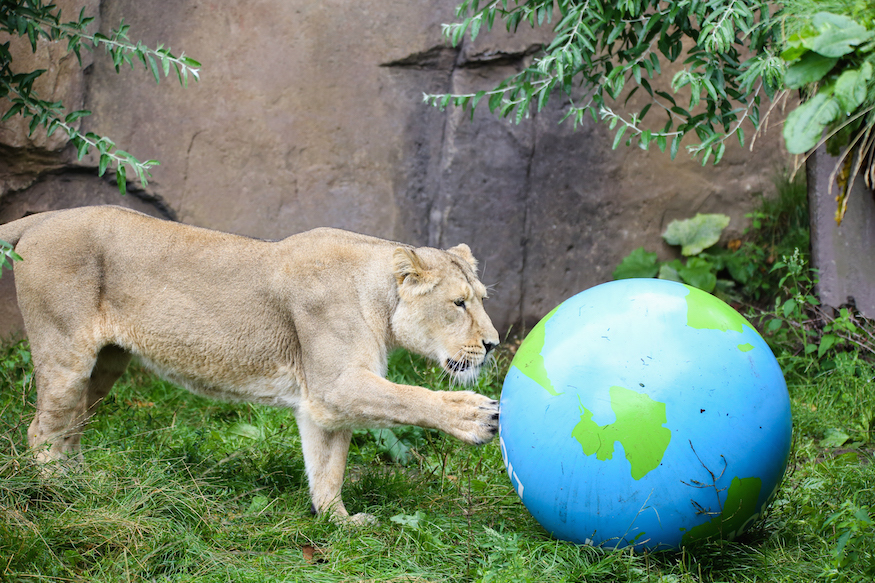
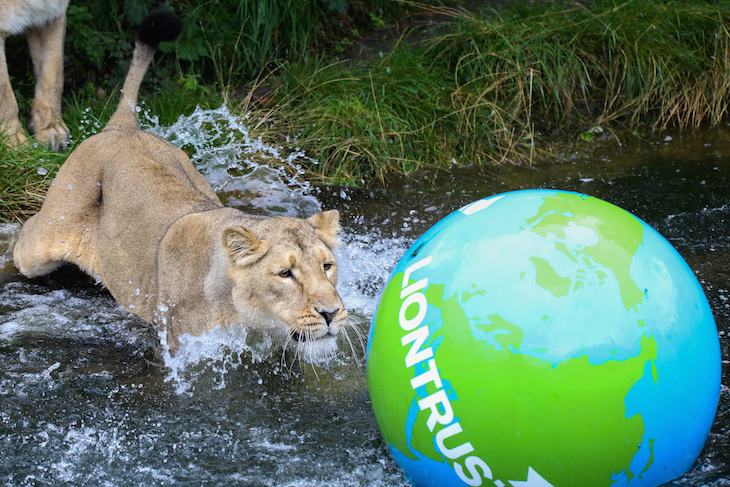
ZSL London Zoo's lionesses, Rubi, Heidi and Indi were given a boomer ball designed like the Earth, to mark three years of support from Liontrust. The asset fund management company helped to build London Zoo's Land of the Lions, and supports ZSL's conservation work in the Gir Forest in India.
(c) ZSL
Boomer balls are designed for large, strong, animals to play with. This one, which is a metre wide, was scented with aromatic herbs and spices to keep the lions interested in it.
(c) ZSL
Zookeeper Lucy Reed said:
As an international conservation charity, our work extends far beyond the boundaries of ZSL London Zoo. The pride of Asiatic lions, and indeed their home at Land of the Lions, are ambassadors for the work we’re supporting in the Gir Forest, Gujarat, India — the Asiatic lions’ last remaining stronghold, where just 500 remain.
(c) ZSL
We’re grateful to be celebrating three years with Liontrust on World Lion Day. Their support has helped us to build a magnificent new home for our big cats, and supports our ongoing work in the Gir National Park.
Check out this video of the big cats getting stuck into their new toy:
Last Updated 10 August 2017

https://londonist.com/london/weekend/in-photos-london-zoo-s-lions-celebrate-world-lion-day

World Lion Day 2017: 5 Reasons To Love The Biggest, Loudest Cat

Did you know lions count, or why they roar so deeply? Here are some reasons to love lions on World Lion Day Thursday, Aug. 10, 2017.

By Updated August 10, 2017 10:33 am ET
World Lion Day 2017: 5 Reasons To Love The Biggest, Loudest Cat
Lions are among nature’s most majestic creatures and have been woven into religion and culture since the beginning of time. But they could be gone from the planet in about three decades without dramatic conservation efforts, according to the founders of World Lion Day, a Thursday, Aug. 10, observance spreading awareness about the “vulnerable” African lion and “endangered” Asiatic lion.
The decline of lions has been steep and dramatic. Millions of lions roamed the globe 2,000 years ago, but only about 20,000 remain today, living primarily in Africa, except for about 300 Asiatic lions living in India’s Gir Forest. Lion numbers have plummeted 43 percent in 21 years, or about three generations, due to indiscriminate killing in defense of human life or livestock, habitat destruction, poaching and the bush meat trade, according to the IUCN Red List of Threatened Species.
There are many ways to observe World Lion Day and celebrate the species. Here are five reasons you should love lions:
Hear me roar: Male lions have deep, loud roars that can be heard up to 5 miles away. Tigers and jaguars also roar, but with a higher pitch. Scientists can’t account for the difference in tenor but believe lions roar to communicate and that male lions stake out territory with their ferocious roars.
Oh, you sexy thing: The males have gorgeous manes of fur, which is unique among cats. Charles Darwin, one of the originators of the theory of evolution, and other scientists once falsely thought the manes offered a thick layer of protection against injury during fighting. A 2006 scientific study basically showed that male lions toss and flaunt their manes in a sexual come-on to lioness.
Sisters for life: Males lions roam all over the countryside catting around, so to speak, but lionesses remain with their siblings, mothers and other preceding generations for life — or at least for the most part. The exceptions are the lionesses that spirit away when a new male lion swaggers in and deposes the pride leader, then kills his offspring to establish his own blood line. Females that do stray from the territory they were conceived in face a grim future alone. The naturally roaming males become fierce hunters, but pride-bound females unable to fend for themselves face drastically lower chances of survival.
One, two, three: Lions can count. Scientists say they count the number of roars they hear from competing prides to calculate both their strength and whether it’s safe to attack. Craig Packer, a University of Minnesota ecologist and one of the world’s top lion experts, concluded in long-running studies of African lions that they developed the ability to count as part of their continued evolution to dominate, not share, the savanna.
Don’t turn your nose up at that: Lions respond to foul smells the same way you might, by screwing your face into a contorted frown, wrinkling your nose and pulling back your lips in a pinched grimace. The expression as cats draw the acrid scent of another lion’s urine into their nostrils is known as the Flehmen response. The lion looks ferocious and threatening, but the display is simply a natural response as the scent passes over the cat’s vomeronasal organ, an auxiliary olfactory sense organ that is found in many mammals.
Photo by Cameron Spencer/Getty Images News/Getty Images
https://patch.com/us/across-america/world-lion-day-2017-5-reasons-love-biggest-loudest-cat

5 Strange Big Cat Facts for World Lion Day

  • By: joelb
  • August 9, 2017
It’s World Lion Day! To celebrate and educate, here are five facts about our most iconic big cat:

1) Lion Populations Range from Vulnerable to Endangered

You don’t hear as much about lion conversation as, say, tigers, but all lion populations are classified as one of three categories of “threatened” on the IUCN Red List scale. Some of the people I’ve mentioned this to were surprised to find it out. Most recognized sub-species are classified as vulnerable, but the only non-African population, the Asiatic Lion is classified as endangered.
The Asiatic Lion subspecies once lived in Ancient Persia, Mesopotamia, and Turkey but has been reduced to only one population in Gir National Park in India. There are currently about 650 Asiatic Lions left. Biologists think lions first evolved in Asia before spreading throughout and from the continent, but it is the remaining Asian population that is most at risk.
The major issue for all lions is habitat loss. Fortunately, it has protected status in India and the population has been trending upward. Let’s keep it up!

2) Lions Have Gone Extinct Before

Lions throughout northern, western, and central Africa are more similar genetically to India’s lions than to lions found in eastern or southern Africa, across the Great Rift Valley. It’s likely that the lion populations here previously died out and the land was later reclaimed from lions coming out of Asia.

Love This? Never Miss Another Story.

More dramatically, two sub-species of lions died out at the end of the last ice age as part of a major extinction event. The late Pleistocene extinctions 10,000 years ago, which humans spreading to new areas is believed to have contributed to, resulted in the disappearance of the American Cave Lion and the European Cave Lion, reducing the lion’s range from four continents to two.
While it’s strange to imagine lions sauntering around the South of France or the Arizona desert, there are plenty of fossil remains which reveal this former range.

3) Lions Have Cousin Species

Lions, with the species name panthera leo, have four cousins within the panthera genus: tigers (panthera tigris), leopards (panthera pardis), snow leopards (panthera uncia), and jaguars (panthera onca). The unique roar is shared. Note that cheetahs are not closely related.
Jaguars are the closest cousin of lions found in the Americas, formerly in Mexico and the southern United States but today mainly Central and South America.
What about the mountain lions, found throughout Canada and the United States? Despite their name and appearance they are not closely related to the panthera big cats, just as marsupial koala bears are not actually bears.
And cougars, pumas, even the Florida panthers? Still the same non-panthera species, puma concolor, with different local names. Lions are the only big cats with manes, however.

4) Lions Really Are King of Their Ecosystem (Which Isn’t the Jungle)

Lions are most famous for their stalk-and-ambush hunting strategy, getting close to prey animals like gazelle or wildebeest without being noticed and then leaping out of the tall grass in a short burst of speed in the hot Savannah afternoon.
But lions often hunt at night when it is cooler, and they have been known to coordinate to tackle huge prey animals. Lions can even take down elephants, something no other big cat could do, lacking either the size or the teamwork of lions.
Lions are also opportunists, driving off leopards or even hyenas from a fresh kill, limiting the smaller predators to what they can cram in their mouths as the lion pride leisurely approaches to take over. Their resourcefulness and innovation is why the lions are at the top of their food web, with other top predators bowing down to them.

5) Lions Were Semi-Mythical in Many Cultures

If you’re familiar with Chinese culture you may have seen the common architectural feature of stone lions guarding an entryway. Although lions were never native to the country, they have a millennia-long history in Chinese art and culture as a symbol of strength and protection, alongside dragons and other never-seen creatures.
The path to manhood in Maasai tradition involved facing a lion, and the connection to this culture is one reason the Maasai people have adjusted their practices to protect the population. This was no mythical creature, but it was a near-sacred and respected opponent.
In Britain, again, far from any living lions at the time, the species was known to scholars and the general public, albeit in somewhat of a folklorish way, as illustrations depicted them alongside unicorns and dragons. And of course, King Richard of England styled himself “the lion-hearted” rather than referencing a local, but less impressive animal.
The lion exemplifies the word iconic. I mean that in the most literal way, as it has become an icon, appearing in battle standards, family and royal crests throughout Europe, even national and regional flags in places as disparate as Tibet and France. There may not be any dragons or unicorns around, but we can help lions thrive for generations to come.
Image credit: Wikimedia/Briton Riviere 1881

http://www.care2.com/causes/5-strange-big-cat-facts-for-world-lion-day.html

London Zoo welcomes first ever 'sacred' baby monkey

This special new arrival is not only extremely cute, but considered 'sacred' as it is named after a Hindu god
By 09:30, 6 AUG 2017
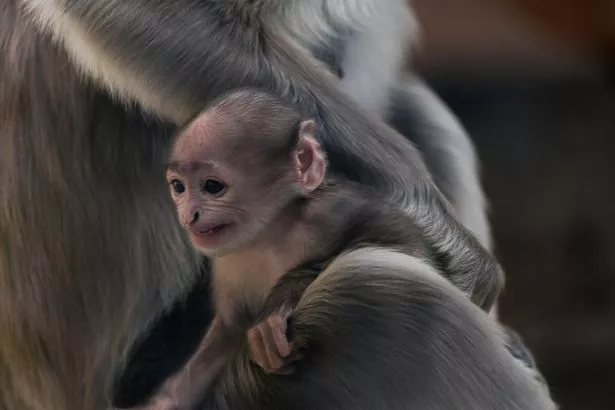
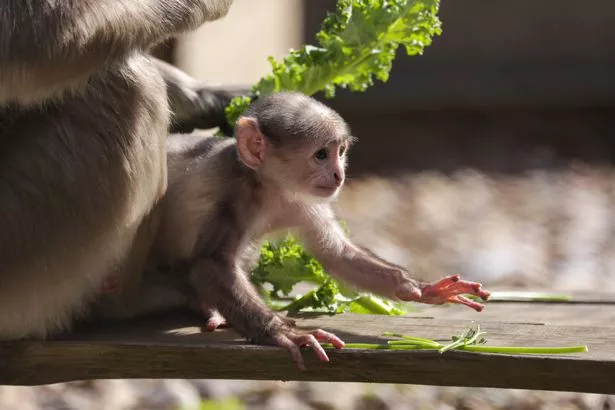
Zookeepers at ZSL London Zoo are celebrating the arrival of a baby monkey considered sacred by Indian holy men.
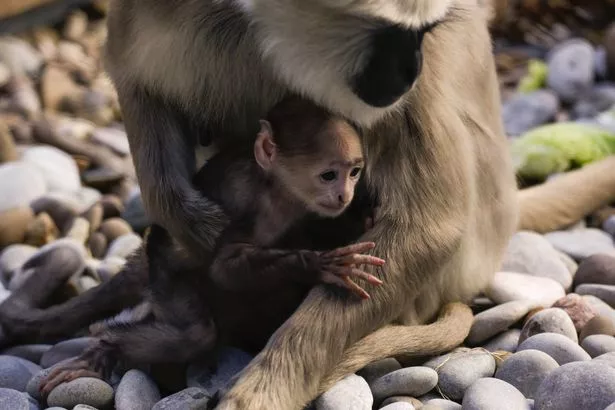
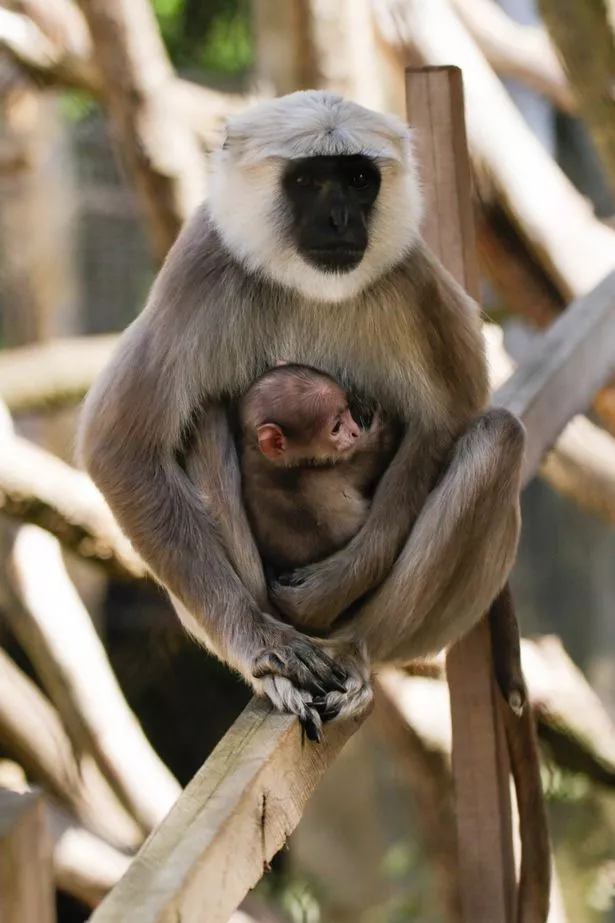
The Hamuman langur monkey, the first ever to be born at the Zoo’s Land of the Lions exhibit, is named after the Hindu god Hanuman.
Born to first-time parents Saffron and Rex after a 200-day gestation, zookeepers were delighted when they first spotted the tiny arrival - named Kamala - last month.
Video footage shows the young primate finding her way around her new home
Remarkable footage from inside the zoo's enclosure captures the young monkey bonding with her parents and starting to find her way around her new home.
Zookeeper Agnes Kiss said: “The first Hanuman langur to be born to this troop at ZSL London Zoo and the first new arrival at Land of the Lions, this tiny primate is an exciting symbol of the success of this project.
“To mark the occasion, we’ve called her Kamala, which means lotus flower in Gujarati – the sign of beauty, fertility and prosperity. Everyone is very pleased with Kamala’s progress so far.
“At the moment, she has a pale face and downy dark fur, but it won’t be long before her skin turns black and her coat thickens and turns a magnificent silver - just like her parents.
The newborn is called Kamala, which means lotus flower in Gujarati – the sign of beauty, fertility and prosperity
“She’ll also grow into her large ears, which are perfect for picking up subtle noises over long distances.
"In the Gir National Park [Gujarat, India], Hanuman langurs act as an early warning system for other wildlife – making loud ‘barks’ from high in the treetops to warn of a lion’s approach.
"In Land of the Lions the troop can often be heard vocalising in response to the lions’ roars, which Kamala will learn how to do from her parents.”
Baby Kamala was born on Sunday (July 23) at London Zoo
Land of the Lions, which opened last year, is also home to ZSL’s Asiatic lion pride - male Bhanu and lionesses Heidi, Indi and Rubi.
The exhibit tells the story of the Gir, a unique area that is home to the last wild population of the Critically Endangered lion species.
Hanuman langurs are widespread throughout Asia, and are named after the Hindu god of healing and worship. By contrast, there are just 500 Asiatic lions left in the wild.
Kamala’s upbringing is already a community affair, which is natural for Hanuman langurs.
Dad Rex is staying protectively close to his first born, while another female, Lucy, has been spotted carefully carrying Kamala around - giving Saffron a well-deserved rest.
The 'sacred' baby monkey is still finding her way around
Visit ZSL London Zoo this summer to see Kamala and more than 18,000 other animal residents, and enjoy a really great day out that makes a real difference.

http://www.getwestlondon.co.uk/news/west-london-news/london-zoo-welcomes-first-ever-13437069

Gir forest Asiatic lion brimming population needs translocation to Madhya Pradesh...

http://www.indialivetoday.com/gir-forest-asiatic-lion-brimming-population-needs-translocation-madhya-pradesh/184893.html

Read more at: http://www.indialivetoday.com/gir-forest-asiatic-lion-brimming-population-needs-translocation-madhya-pradesh/184893.html

Into the wild: Here’s a checklist of unexplored wildlife destinations in India

India is home to exotic wildlife and plants. Here are some of the offbeat wildlife sanctuaries to check out.

travel Updated: Aug 04, 2017 15:01 IST
Kumbhalgarh Wildlife Sanctuary takes its name from the nearby Kumbhalgarh fort, which offers a spectacular view of the wildlife reserve.
Kumbhalgarh Wildlife Sanctuary takes its name from the nearby Kumbhalgarh fort, which offers a spectacular view of the wildlife reserve. (Shutterstock) 

Wildlife is perhaps one of nature’s most precious gifts to humankind. Although, there are lots of places globally that are known for their exotic range of wildlife, India is home to some of the most magnificent creatures and plant life in the world. While there are several popular wildlife sanctuaries like Corbett National Park, Gir Forest National Park and Kutch Desert Wildlife Sanctuary, among others, there are some natural reserves yet to be explored. Explore those lesser known wildlife destinations as listed by Jayanth Sharma, co-founder and CEO at Toehold:
* Kumbhalgarh Wildlife Sanctuary:Kumbhalgarh Wildlife Sanctuary is a beautiful gem bordered by the Aravalli range in the Pali, Udaipur, and Rajsamand district in the state of Rajasthan. The reserve is home to some of the most endangered species in India, such as leopards, wolves, nilgai, chinkara and sloth bear. It also houses various species of birds like peacocks and doves. The sanctuary takes its name from the nearby Kumbhalgarh fort, which offers a spectacular view of the wildlife reserve. The reserve has been selected for the Asiatic lion reintroduction project by the Indian government.
How to go: Kumbhalgarh Wildlife Sanctuary is situated at a distance of 85 km from Udaipur airport. The nearest railway station is Falna.
Aralam Wildlife Sanctuary is covered in tropical and semi-evergreen forests and protects a host of different species of flora and fauna. (Shutterstock)
* Aralam Wildlife Sanctuary: Situated in the northernmost part of Kerala in Thalassery, Kannur, Aralam Wildlife Sanctuary is an important natural reserve in India. Established back in 1984, the sanctuary is spread across 55 sq km of forested highland along the famous slopes of the Western Ghats. The reserve is covered in tropical and semi-evergreen forests and protects a host of different species of flora and fauna. Some of the native wildlife species that Aralam features are spotted deer, elephants, gaur, langurs, and the Malabar giant squirrel.
How to go:
Thalassery railway station is 55 km from the reserve. You can also reach there via flight to Calicut International Airport, which is situated around 96 km from the town of Thalassery.
* Bhimgad Wildlife Sanctuary:Another gem of the Western Ghats, the Bhimgad Wildlife Sanctuary is a well-known attraction in the Belgaum district of Karnataka. The sanctuary is mostly visited for its Barapede caves, which is the only recorded breeding area of the Wroughton’s free-tailed bat — a species of the nocturnal mammal that is on the verge of becoming extinct. Officially listed as a wildlife sanctuary in 2011, Bhimgad Wildlife Sanctuary abounds in tropical and subtropical, moist broadleaf forests as well as several species of medicinal plants. Park officials organise adventure camps for people of all ages, making it an ideal destination for adventure lovers and nature enthusiasts.
How to go:
The park is about 35 km from the city of Belgaum, and is accessible by road.
You can spot nilgai at the Kumbhalgarh Wildlife Sanctuary. (Shutterstock)
* Gautala Autramghat Sanctuary: The Gautala Autramghat Sanctuary is a protected area situated at a distance of 60 km from the city of Aurangabad in Maharashtra. The reserve spans across 64,399 acres, and is made up of grasslands and southern tropical dry deciduous forest cover. The wildlife reserve is home to several animals like the wanderoo (langur), leopards, wild boar, and barking deer, and over 240 species of birds, such as storks, cranes, quail, and partridges. It is also a great place to spot reptiles like cobra, python, and monitor lizard.
How to go: Aurangabad airport and railway station are the nearest points to reach Gautala Autramghat Sanctuary.
Apart from the parks and reserves mentioned above, other wildlife destinations include Mollem National Park, Achanakmar Wildlife Sanctuary, Barnawapara Wildlife Sanctuary, Khangchendzonga National Park, and Namdapha National Park.

http://www.hindustantimes.com/travel/into-the-wild-here-s-a-checklist-of-unexplored-wildlife-destinations-in-india/story-WVKsdLNAhddUXOqYaPDfUP.html