Rhett Butler, mongabay.com
December 28, 2011
We at mongabay readily acknowledge there were a number of important temperate and boreal forest developments, including Britain's decision not to privatize its forests and the severe drought in Texas, but this article will cover only tropical forest news.
Brazil
Brazil announced forest loss during the 2010-2011 deforestation year fell to the lowest level since annual record keeping began in 1988, a continuation of a three-year trend. But enthusiasm for the news was tempered by other developments that could increase risks to the Amazon. In December the Senate voted to revise the country's long-standing Forest Code, a move environmentalists fear could spark deforestation. The existing Forest Code, which is largely dysfunctional due to lack of consistent enforcement, requires landowners to main 80 percent forest cover on their properties. The new code, which will face a final vote in February or March before going to President Dilma Rousseff for approval, would maintain the headline 80 percent figure in the Amazon, but grant amnesty for illegal deforestation through July 2008 on properties up to 400 hectares (1000 acres) (some greens fear worry the deadline may shift in the future). The new Forest Code would also suspend fines — which fund law enforcement — and relax restrictions on forest clearing along rivers and on mountaintops. Green groups said the proposed code is unpopular, according to a poll they commissioned.
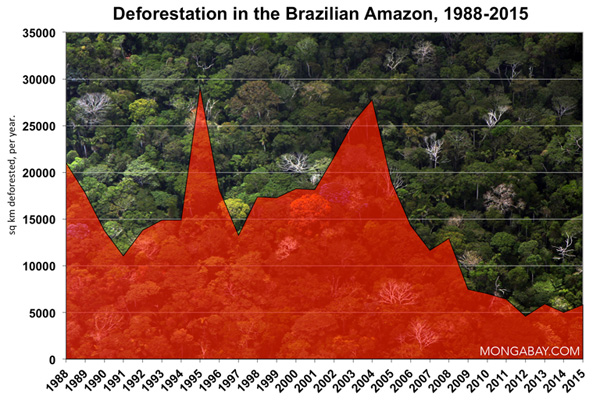
Deforestation in the Brazilian Amazon, 1988-2011. Photos by Rhett A. Butler.
Another major development in 2011 was the decision to move forward on Belo Monte dam, a project that would block most of the mighty Xingu river, flooding more than 40,000 hectares of rainforest and displacing thousands of indigenous people. Most disturbing about Belo Monte is the precedents it sets for future large-scale infrastructure projects in the Amazon. For example a federal judge ruled in November that affected communities do not have the right to free, prior and informed consultation on the project. Meanwhile Brazilian companies continued to invest in projects that would drive large-scale deforestation in other Amazon countries, including dams, energy exploration, industrial agricultural developments, and new roads, suggesting that even though deforestation has been ebbing in recent years, there may be leakage to surrounding countries.
News of infrastructure investment and development came at the same time as a series of high profile assassination of anti-illegal-logging activists in the Amazon by ranchers and loggers.
Some positive news emerged on Brazil's most threatened forest ecosystem. The National Institute for Space Research (INPE) and Fundação SOS Mata Atlântica announced the deforestation rate for the Mata Atlântica (Atlantic Forest) dropped significantly between 2008 and 2010, relative to the 2005-2008 period.
Finally there were signs some private sector actors continued to be motivated by the stigma of deforestation in their supply chains. JBS-Friboi, the world's largest meat processor, announced it would stop buying beef from ranches associated with slave labor and illegal deforestation in the Brazilian Amazon, while several banks were sued for failing to follow lending safeguards designed to prevent public finance from being used to subsidize deforestation.
Indonesia
In Indonesia, environmental groups set their sights on the pulp and paper sector, which over the past twenty years has emerged as one of the biggest drivers of deforestation on the island of Sumatra. Asia Pulp & Paper (APP) and Asia Pacific Resources International Limited (APRIL), the two largest fiber suppliers, were the main targets. Greenpeace used fiber found in toy packaging and toilet as the main hook for their campaign, which relied heavily on social media, including a video suggesting that deforestation was the cause of a breakup between Ken and Barbie, popular Mattel toys. Meanwhile reports from Eyes on the Forest, a coalition of Indonesian environmental groups WWF-Indonesia, and Greenomics cast doubt on some of APP's conservation claims, while an APP subsidiary in Australia was scandalized when caught in an astroturfing campaign intended to suggest broad public support for the company, when in fact there was little. The controversy, amid long-time complaints about APP's environmental record, led Lego, Mattel, Kroger, and others to drop APP as a supplier. APRIL was hit hard by an investigative report by ABC (Australia) News, which raised questions about its forest management practices and a stalled illegal logging investigation.
But the forestry sector fought back. U.S.-based groups that advocate on behalf on APP launched a series of campaigns targeting Greenpeace, WWF, the Rainforest Forest Network, and companies that have dropped APP products. One even launched an anti-Greenpeace web site and hosted comments on its Facebook page calling for violence against members of the green group. In Indonesia, pressure was more direct, with both Greenpeace-Indonesia and Indonesia Corruption Watch suffering unusual levels of harassment.
More broadly, Indonesia finally passed its much heralded moratorium on new logging and plantation concessions on peatlands and in primary forests areas, but the moratorium was much weaker than expected, reflecting the influence of business-as-usual interests in the forestry sector on the Indonesian government. The moratorium had substantial loopholes, including exclusions for industrial agriculture and mining. But the passage of the moratorium at all, reflected Indonesian President Susilo Bambang Yudhoyono's seemingly intensified commitment to reducing deforestation. President SBY touted his 7/26 initiative, which targets 7 percent annual economic growth and a 26 percent reduction in greenhouse gas emissions by 2020 relative to business-as-usual. Reducing deforestation and peatlands degradation is the centerpiece of his push toward low carbon development. Indonesia signed a Voluntary Partnership Agreement (VPA) with Europe to keep illegal Indonesian wood out of European Union markets.
Meanwhile one major palm oil producer broke ranks and took a bold step forward: Golden Agri Resources (GAR), which had been the target of an intense Greenpeace campaign, announced one of the most progressive forest policies in the palm oil sector, committing not to develop lands with carbon stocks greater than 35 tons per hectares and promising to seek "free, prior informed consent" in engaging with communities. Environmentalists hoped other forestry companies would follow GAR's lead (another palm oil company ceded land in Kalimantan contested by local communities as part of sustainability pledge). Moreover, the Indonesian government said it would 'recognize, respect and protect' the rights of traditional forest users, including indigenous people, a move civil society believes is key to reducing deforestation.
Papua New Guinea
Papua New Guinea, the independent half of the island of New Guinea, saw several significant developments in the forestry sector.
In May, the government suspended its controversial Special Agricultural and Business Leases program (SABLs), which had granted logging and plantation development concessions to mostly foreign corporations across 5.2 million hectares of community forest land. SABLs had been widely opposed by community rights groups and conservationists.
In June, a court fined Concord Pacific, a Malaysian timber company, with a nearly $100 million (K225.5 million) fine for large-scale illegal logging. The firm was ordered to pay damages to four forest tribes. It was the first ruling of its kind in Papua New Guinea.
Sir Michael Somare resigned the office of prime minister, creating further uncertainty around the country's faltering REDD program. Communities in PNG have been plagued by an influx of "carbon cowboys", unscrupulous forest carbon project developers that, at times, have swindled locals out of their land and savings.
Africa
The Republic of Congo announced it would seek international funding for a plan to convert up to one million hectares (2.47 million acres) of "degraded forest" lands into industrial plantations. While the government said the intent of the program was to to sequester carbon and take pressure off native forests, environmentalists immediately expressed concern that the proposal could drive destruction of native forests, to the detriment of biodiversity and carbon stocks.
Liberia signed a Voluntary Partnership Agreement (VPA) to facilitate timber exports to Europe by ensuring no wood has been illegally cut.
A group of African nations re-introduced a decades-old plan to establish a "Great Green Wall" to stem expansion of the Sahara Desert. The massive tree-planting exercise would be backed by donor funds.
A controversial oil palm plantation in Cameroon was put on hold after concerns were raised about its social and environmental impact.
Uganda resurrected a plan to hand over about a quarter of the Mabira Forest Reserve to a sugar cane company. The project had been shelved in 2007 due to public uproar.
India
The Indian government announced in February an initiative that will "expand" and "improve the quality" of its forests as a part of the nation's National Action Plan on Climate Change. The reforestation plan, dubbed the National Mission for a Green India (NMGI), will expand forests by five million hectares (over 12 million acres), while improving forests quality on another five million hectares for $10 billion (460 billion rupees). It wasn't specified whether the new "forests" would be native or exotic plantations.
Conservation officials will pursue "permanent" protection of Jeypore-Dehing lowland rainforest in Assam, following the release of photos revealing the presence of seven wild cat species. The forest is currently threatened by logging, poaching, oil and coal development, and hydroelectric projects.
The high profile push to protect tigers will hurt lion conservation in India. The Asiatic lion subspecies (Panthera leo persica) of Gir Forest National Park in the north-western state of Gujarat is losing their federal conservation funding to tiger programs.
A mess in Sarawak, Malaysia
Indigenous forest people in Sarawak continued their struggle against forestry companies backed by the state government. Forest-dwelling Penan set up several roadblocks against logging and plantation companies, but continued to see court rulings in their favor ignored by authorities. In June, Survival International reported a thousand Penan were forcibly moved from their rainforest home to palm oil plantations to make way for the Murum dam.
Meanwhile, evidence of large-scale corruption by Sarawak's Chief Minister Abdul Taib Mahmud continued to grow. A handful of countries, including Malaysia, said they are now investigating Taib's assets, which are believed to be worth billions of dollars, despite the minister drawing a civil servant's salary for the past 30 years. The Bruno Manser Fund, which campaigns heavily against Taib, says much of the wealth is derirved from the minister's close ties to the logging and plantation sector. The U.S. State Department apparently agrees, according to diplomatic cables released by Wikileaks.
Taib maintains his innocence and even claimed #&8212; in March #&8212; that Sarawak's forests are "70 percent intact". He was quickly rebuked however by images on Google Earth, which reveal a stark contrast between Sarawak's damaged forests and those in neighboring Borneo states. Taib claims were also contradicted by an analysis by environmental group Wetlands International and remote sensing institute Sarvision showing that more than one third (353,000 hectares or 872,000 acres) of Sarawak's peatswamp forests and ten percent of the state's rainforests were cleared between 2005 and 2010. About 65 percent of the area was converted for oil palm, which is replacing logging as timber stocks have been exhausted by unsustainable harvesting practices.
Intergovernmental forest activities
REDD+, a program proposed to reduce greenhouse gas emissions from deforestation and degradation, made mixed progress during December climate talks in Durban. Forestry experts said while some key issues were resolved, significant questions remain about financing and safeguards to protect against abuse. REDD+ offers the potential to simultaneously reduce emissions, conserve biodiversity, maintain other ecosystem services, and help alleviate rural poverty, but concerns over potential adverse impacts have plagued the program since its conception.
The U.S. announced a debt-for-nature swap worth $28.5 million to back forest conservation projects in Kalimantan. America also began distributing the first grants under a similar 2009 program in Sumatra. The U.S. State Department said it has pledged more than $450 million toward 'green growth' in Indonesia.
California approved cap-and-trade regulations for AB32, the state's 2006 climate law. The move, which establishes the first compliance carbon trading system in the United States, opens the door for compliance-level carbon offsets generated via forest conservation projects. California has signed working agreements with several states and provinces in Brazil, Indonesia, and Mexico.
The World Bank announced it would resume lending to palm oil sector after 18-month moratorium sparked by complaints over social conflict between local communities and palm oil companies in Indonesia. Lending will be governed by a framework developed after months of consultations with stakeholders, including the private sector, NGOs, farmers, indigenous communities, development experts, and governments. A prominent lobbyist for the palm oil industry decried the safeguard provisions.
Lessons from the past?
Researchers at the American Geophysical Union (AGU) conference presented new evidence that the Maya ultimately did themselves in through deforestation. Climatologist Ben Cook reported the extent of forest clearing toward the end of the Mayan civilization may have been enough to reduce rainfall to the point that it unleashed devastating droughts.
On the drought front, troubling signs emerged out of the Amazon rainforest, according to new studies which examined the 2005 and 2010 droughts in the region. One concluded that nearly one million square miles (2.6 m sq km) of rainforest was affected by last year's drought, making it worse than the 2005 drought, which until then had been the worst on record. Meanwhile a subsequent projection by Brazil’s National Institute for Space Research (INPE) and the UK's Met Office Hadley Centre concluded that climate change and deforestation could decimate much of the Amazon by reducing the resistance of the rainforest ecosystem to natural and human-caused stressors, while increasing the frequency of extreme rainfall events and droughts. Amazon die-off could have dire implications for South America's economy — roughly 70 percent of the continent's GDP occurs within the rain shadow of the Amazon rainforest.
The high price of gold and other commodities
The surging price of gold drove expansion of mining in tropical forests around the world. In Peru the impact was particularly pronounced, with several massive surface mines metastasizing across the most biodiverse part of the Amazon rainforest.
Oil palm, industrial pulpwood, and timber plantations continued to expand around the tropics, stoking growing criticism from environmentalists and social justice movements. High prices for palm oil, timber, woodpulp, and other commodities make it more profitable to clear and convert forests.
Plans for new dams and energy exploration were put forth in tropical forests around the world. In Peru, conflicts between oil companies and indigenous tribes simmered, while Ecuador's proposal to leave oil in the ground in Yasuni National Park failed to gain traction as the development community seemed unwilling to cough up funds for the initiative. Also in Ecuador, Chevron was ordered to pay more than $8 billion for damages allegedly caused by Texaco, a company it acquired in 2001. Chevron is appealing the case, which has dragged on for nearly 20 years.
Successful campaigns elsewhere
In Sri Lanka, fruit company Dole abandoned a controversial banana plantation within Somawathiya National Park after protests by local environmental groups.
After a protracted and embarrassing campaign that saw it censor its own members and shut down the ability to comment on its Facebook page, Girl Scouts USA announced it would change its palm oil sourcing policy. The group will now use only RSPO-certified palm oil, which is produced under stricter criteria than conventional palm oil.
In Bolivia, intense indigenous demonstrations forced President Evo Morales to drop plans to build a road through Tipnis, an indigenous reserve.
In Myanmar, protests astonishingly pushed the government to cancel a major Chinese dam.
In Cambodia, local campaigners successfully pressured the government to cancel titanium strip mine project.
In Sabah, Malaysia, local activists cheered the government's decision to cancel a controversial a coal-fired plant on the edge of the Coral Triangle. The project, which the government had earlier said was 'a done deal' would have increased pressure to strip mine rainforests in Malaysia and Indonesian Borneo for coal. The cancellation followed a long campaign by a group of environmental and human right organizations dubbed Green SURF (Sabah Unite to Re-power the Future), which turned the coal plant into a political issue.
A large Brazilian construction company pulled out of a Peruvian dam project in November citing opposition from indigenous communities.
Certification
Commodity roundtables — multistakeholder bodies that aim to create production standards for commodities — continued to meet to discuss certification criteria and ways to create incentives to improve their environmental and social performance. Nevertheless roundtables continued to by criticized by non-members NGOs concerned about standards and oversight, as well as non-member producers worried about competition. Roundtables globally won support when McDonald's launched a new sourcing policy — the Sustainable Land Management Commitment — for palm oil, paper, beef, coffee, soy, and other commodities.
The Forest Stewardship Council (FSC) met for its General Assembly, which weighed various changes to the organization, including a vote on a controversial motion that would open the door to sustainable-certification of companies that have been involved in recent forest destruction for pulp and paper plantations. The FSC faced questions over violent conflict in a certified concession in the Democratic Republic of Congo (DRC), its pursuit of carbon credits from forestry, and its certification of a plantation where large numbers of primates had been killed. FSC was buoyed by Danish shipping giant Maersk's decision to transition to containers built from FSC-certified timber.
The Roundtable on Sustainable Palm Oil (RSPO) announced record sales of certified palm oil and saw a number of high profile buyers commit to sourcing only certified palm oil by 2015, a continuation of a trend. Further support came from a Dutch industry group, which said it would seek import duty exemption for RSPO-certified palm oil, and new legislation in Australia and the E.U. requiring labeling of palm oil as an ingredient on packaging. The initiative however was tested by non-compliance by some members. RSPO suspended IOI, a Malaysian giant, for its role in a land use dispute with forest people in Borneo. Another prominent RSPO member, Wilmar Corp, was accused of misleading the public over a conflict between local communities and one of its subsidiaries in Sumatra. Finally, the Malaysian government announced its own certification standard based on compliance with Malaysian law. Naturally, the standard is mandatory for Malaysian palm oil producers. Indonesian proposed a similar legal compliance-based standard — the ISPO — in 2010.
A new assessment by the International Tropical Timber Organization (ITTO) concluded that more than 90 percent of tropical forests are managed poorly or not at all.
Community rights
Momentum seemed to build for increased community control over forest lands. A paper published in Science in March found that involving local communities in the governance of forest resources boosts economic returns and biodiversity relative to areas where locals have little participation, while research published in July by the Rights and Resources Initiative (RRI) concluded that giving local communities control over forest resources can help slow and even reverse deforestation. Shortly thereafter the Indonesian government said it would do more to strengthen and protect the rights of traditional forest users, after an initial false-start under the country's moratorium. A subsequent World Bank study published in the open-access journal PLoS ONE concluded that protected areas in tropical forests are better at curtailing deforestation if they allow 'sustainable use' by locals. Looking at every official protected area in the tropics from 2000 to 2008, researchers found that multi-use reserves in Latin America and Asia lowered deforestation rates by around 2 percent more than strict protected areas.
An indigenous community in Malaysian Borneo took land rights into its own hands when it seized an oil palm plantation belonging to the IOI Group after the palm oil giant failed to respect the terms of a court ruling that the plantation was established on native customary land.
In September Peru's newly elected president, Ollanta Humala, signed into law a measure requiring that indigenous groups are consulted prior to any mining, logging, or oil and gas projects on their land. If properly enforced, the new legislation will give indigenous people free, prior and informed consent (FPIC) over such industrial projects, though the new law does not go so far as to allow local communities a veto over projects. Still, the law puts Peru in line with the Indigenous and Tribal Peoples Convention of 1989, which the South American nation ratified nearly two decades ago.
In December, the Rainforest Foundation UK announced an initiative to help forest communities gain recognition of traditional land use. Similar community mapping efforts at large scale are underway in Indonesia.
Strange bedfellows
Gibson Guitars found an ally in the Tea Party when its CEO criticized the federal government for raiding its facilities during an investigation into alleged illegal wood-sourcing. Gibson was first raided in 2009 when it allegedly imported illegally logged ebony from Madagascar's rainforests. Email correspondence from the time show that Gibson knew the timber was grey-market. But it was a subsequent raid earlier this year which sparked charges of government over-reach. The Department of Justice has been slow in pursuing the case, but Gibson now seems to have capitalized on the allegations as a promotional platform. Gibson has now become the cause célèbre for an effort to weaken the Lacey Act, which prohibits imports of illegally-sourced plant products. The push is backed by pulp and paper companies, which fear prosecution if protected timber species end up in their products.
BINGOs under pressure
Two big conservation groups landed in hot water when they were linked to controversial partners. The World Wide Fund for Nature (WWF) was the subject of a report from Global Witness which said the forest giant's Global Forest and Trade Network (GFTN) has failed to improve the operations of several controversial logging companies, including one that is imperiling orangutans in Borneo and another which has been accused of human rights abuses in the Congo rainforest. WWF said it would commission an independent review of the program. Meanwhile Conservation International was criticized after an undercover video appeared to show a fundraiser for the group offering to greenwash for Lockheed Martin, an arms manufacturer. CI said the video was heavily edited with comments taken out of context.
The Rainforest Alliance was criticized for contributions it received from Gibson while serving as the instrument-maker's auditor. The group declined comment on the matter.
Monitoring deforestation and forest degradation from logging
Advancements continued in efforts to monitor forests, including understanding the impact of drought and selective logging, measuring water flow through forest ecosystems, tracking deforestation and forest degradation, and even assessing biodiversity. The U.N. Food and Agriculture Organization (FAO) announced findings from its long-awaited satellite-based assessment of forest cover. Until now the FAO had based its bi-annual assessments largely on self-reporting by member nations. The preliminary work indicates that global forest cover, as well as forest loss, is lower than previously estimated. But the research indicates that tropical deforestation increased substantially between the 1990s and the first half of the 2000s. The FAO had previously stated the deforestation had declined between the two periods.
A comprehensive assessment of the world's carbon stocks concluded tropical forests across Latin America, Africa, and Southeast Asia stored 247 gigatons of carbon — more than 30 years' worth of current emissions from fossil fuels use — in the early 2000s. The research, published in the journal Proceedings of the National Academy of Sciences by an international team of scientists, used data from 4,079 plot sites around the world and satellite-based measurements to estimate that forests store 193 billion tons of carbon in their vegetation and 54 billion tons in their roots structure. The study produced a carbon map for 2.5 billion ha (6.2 billion acres) of forests.
A separate study led by Mark Broich of South Dakota State University found Kalimantan and Sumatra lost 5.4 million hectares, or 9.2 percent, of their forest cover between 2000/2001 and 2007/2008. The research found that more than 20 percent of forest clearing occurred in areas where conversion was either restricted or prohibited, indicating that during the period, the Indonesian government failed to enforce its forestry laws.
The Carnegie Institution's Department of Global Ecology unveiled a breakthrough remote-sensing technology that enables scientists to catalog individual tree species as they create three-dimensional maps of tropical forests. The newest version of the Carnegie Airborne Observatory (CAO), as the airplane-based system is known, will offer powerful insights into the composition and biology of tropical forests.
Biodiversity
A comprehensive assessment published in the journal Nature concluded that old-growth rainforests should be a top conservation priority when it comes to protecting wildlife. The research examined 138 scientific studies across 28 tropical countries. It found consistently that biodiversity level were substantially lower in disturbed forests and called primary forests "irreplaceable" for sustaining biodiversity. In a similar vein, a Frontiers in Ecology and the Environment paper found that ancient trees are essential for over 1,000 species birds and mammals.
A worldwide search for 'lost frogs' organized by Conservation International drew to a close. The effort, which employed 126 researchers to scour 21 countries for 100 amphibian species, provided further evidence of the dire outlook for many amphibian species, more than a third of which are threatened with extinction.
Researchers sounded the alarm that REDD could introduce a new extinction risk for wildlife: financial markets. The editorial, published in the journal Conservation Letters, argued that REDD could effectively link the fate of some species to the short-term whims of the carbon market. Conservation projects funded primarily by REDD are most at risk of being undermined by declining in carbon prices or changing investor preference.
In March, scientists partnered with one of the world's largest palm oil producers to measure the impact of converting tropical forest into an oil palm plantation.
A plethora of species were described for the first time by scientists in 2011 and studies suggested many more lie in wait of discovery. One noted that despite hundreds of years of research, humanity still knows less than 15 percent of the world's species. Another said that 3,000 amphibians and 160 land mammals remain undiscovered.
While new discoveries may raise hopes, over 900 species were added to IUCN Red List. Two prominent species — both rhinos — made their official exit. Both were driven to extinction primarily by habitat loss, but ultimately finished off by the rhino horn trade. An indeterminate number of other species also roamed the Earth for the last time in 2011, but we'll never know how many left us without a final farewell. Scientists however agree that we are in the midst of an extinction crisis — a survey of 583 conservation scientists found that 99.5 percent believe a serious loss in biodiversity was either 'likely', 'very likely', or 'virtually certain'. But at least one group was hopeful that the planet's sixth mass extinction could be prevented.
Still the news elsewhere wasn't inspiring. A paper in Conservation Letters recorded 89 instances in 27 countries of protected areas being downsized (shrunk), downgraded (decrease in legal protections), and degazetted (abolished) since 1900. Another warned that the global decline in top predators and megafauna is 'humankind’s most pervasive influence on nature'. Still another reported that the world's protected areas won't be enough to stem the loss of biodiversity. It instead argued that society must deal with the underlying problems of human population and overconsumption if we are to have any chance of preserving life on Earth.


