English language news articles from year 2007 plus find out everything about Asiatic Lion and Gir Forest. Latest News, Useful Articles, Links, Photos, Video Clips and Gujarati News of Gir Wildlife Sanctuary (Geer / Gir Forest - Home of Critically Endangered Species Asiatic Lion; Gir Lion; Panthera Leo Persica ; Indian Lion (Local Name 'SAVAJ' / 'SINH' / 'VANRAJ') located in South-Western Gujarat, State of INDIA), Big Cats, Wildlife, Conservation and Environment.
Rajkot: Carcasses of a lion cub and an adult lion were found from different regions of Amreli district on Thursday. In first case, carcass of a cub less than a year old was found Piplva round of Tulsishyam-Khambha range of Gir east forest division from the sanctuary area.
According to forest department the primary reason for the death of the cub is believed to be infighting. Chief conservator of forest (wildlife) D T Vasavda said, “It appears that the cub was killed during infighting. This evident from the external canine marks on the body. It is suspected that a male lion could be nearby.” The postmortem conducted at Kesari sadan indicated deep puncture marks on the cub’s body and a damaged spinal cord. The second carcass found on Thursday was of an adult lion, probabaly around three years old from Mitiyala round in Abharampara revenue area. According to forest officials, the carcass was in decomposed state and there was nothing suspicious found around it. The cause of death, however, will be known after postmortem, the added.
New Delhi (Sputnik): So much for being King of the jungle! A lioness put a lion in his place with some brutal blows to his face in what may have been a lover’s tiff.
A lioness was spotted brutally slapping a male lion on the face and forcing him to back off after he initially tried - and failed - to overpower her. But tourists on safari had a great show and the fighting couple got well and truly papped despite the ugly fight.
Look at that powerful female, but that tight slaps on the face is 🙄. Asiatic lions at Gir. Credits n the video. pic.twitter.com/GvjNK8x2NF
— Sudha Ramen IFS 🇮🇳 (@SudhaRamenIFS) May 27, 2020
It remains unclear whether the fight was a lover’s tiff, a fight for territory or the lioness simply rejecting the lion's desire for sex. https://sputniknews.com/viral/202005271079427516-thats-one-tight-slap-feisty-lioness-strikes-lion-in-front-of-onlookers-on-safari/
TNN | May 27, 2020, 04:48 IST Ahmedabad/Vadodara: Once again, a video purporting to show a tiger in Santrampur, has gone viral. The clip reportedly showed a tiger on the Umber hills in Santrampur taluka in Mahisagar. The clip stirred excitement, galvanizing the officials of the forest department into launching a search. In the end, it was determined that the big cat was a leopard. Forest officials said this is not the first intimation of a tiger in the area. Earlier claims had no photographic or video evidence. But on Monday evening, some locals posted a video of a tiger, apparently seen in the area. In Santrampur, night-vision cameras had been installed after the residents sounded the first tiger alarm. However, the leopard was caught in the camera in this case. “Our team rushed to the area and after a thorough investigation it was established that it was a leopard which the locals had filmed,” said Aradhana Sahu, the chief conservator of forests, wildlife division, Vadodara. In February last year, the forest department had officially confirmed the presence of a tiger in Gujarat, the Asiatic lion’s last abode. On February 12, six days after a school teacher took a picture of a tiger on his mobile phone, the striped big cat was captured in the morning in the advanced night-vision cameras especially mounted by the forest department. The tiger was also spotted in the Santrampur area. However, the animal was found dead on March 1 and reports had indicated that the tiger, entering from Madhya Pradesh, had died of starvation. In the recent case, the excitement had further increased when Rajya Sabha member Parimal Nathwani tweeted the video stating “A video has gone viral in the social media wherein people of Santarampur have claimed seeing a tiger near Umber hills. People believe in the presence of the tiger in the mountains. However, Gujarat forest department has not confirmed the presence of tiger in the area.”
The study claims that due to centuries of inbreeding, Indian lions have cranial defects, low sperm count and testosterone levels, as well as smaller manes.
New Delhi: The near complete absence of genetic diversity in Indian lions is putting the species at risk of extinction, a study of the genomes of extinct and living lions suggests.
Researchers from the University of Copenhagen, Barcelona Institute of Science and Technology and others analysed the remains of the now-extinct lions, including Pleistocene cave lions and other historically extinct populations in Africa and the Middle East.
They compared the results of this analysis with modern lions from Africa and India.
Indian lions have been living in a comparatively small area for centuries and therefore inbreeding often took place, claims the study.
This resulted in cranial defects, low sperm count and testosterone levels, as well as smaller manes, according to the report published in the journal Proceedings of the National Academy of Sciences Thursday.
This lack of genetic diversity may impact the conservation efforts to save the Indian lion population from extinction.
Indian lions were not artificially brought to the country
The study found that cave lions and the modern lions shared an ancestor till about 5,00,000 years ago.
It also discovered that within modern lions, two main lineages that used to live in Central and Western Africa diverged from the ancestors of the subspecies that used to inhabit Northern Africa about 70,000 years ago.
The descendants of the subspecies from Northern Africa inhabit India now, the report found. This suggests that lions migrated through corridors between Sub-Saharan African and the Near East that may have existed in the past, for instance, through the Nile basin.
It dispels a popular myth about lions being artificially brought to India in the pre-colonial era.
“The obtained results demonstrate the power given to us by the era of genome research. We can apply it to discover the secrets of the past by reading the fragments of DNA taken from modern species’ ancestors. Apart from that, a troubling reduction in Indian lion genetic material was proved,” said Stephen O’Brien from the ITMO University in Russia, who was involved in the study.
In the last two centuries, the global population of lions has decreased by 90 per cent. Apart from zoos, these lion populations now only exist in Western and Central Africa, as well as in the Gir National Park and Wildlife Sanctuary in Gujarat.
To understand how the lion population reduced, scientists looked at the genome to understand their evolutionary history.
Fossil records are usually used to understand the movement and evolution of species. However, genome sequencing allows scientists to obtain a more complete picture of the evolution of the species through information encoded in the DNA.
Here, scientists analysed the genome of two extinct Pleistocene cave lions, 12 lions from historically extinct populations in Africa and the Middle East, and 6 modern lions from Africa and India. https://theprint.in/science/indian-lions-at-risk-of-extinction-due-to-lack-of-genetic-diversity-suggests-study/426989/
The names and the sex of the young cubs are still unknown, and they are presently spending quality time alone with their mother By Naama BarakMAY 24, 2020, 8:50 AM
Mom Yasha and her two new cubs enjoy some quality time at the Jerusalem Biblical Zoo. Photo by Yonatan Sindel/Flash90
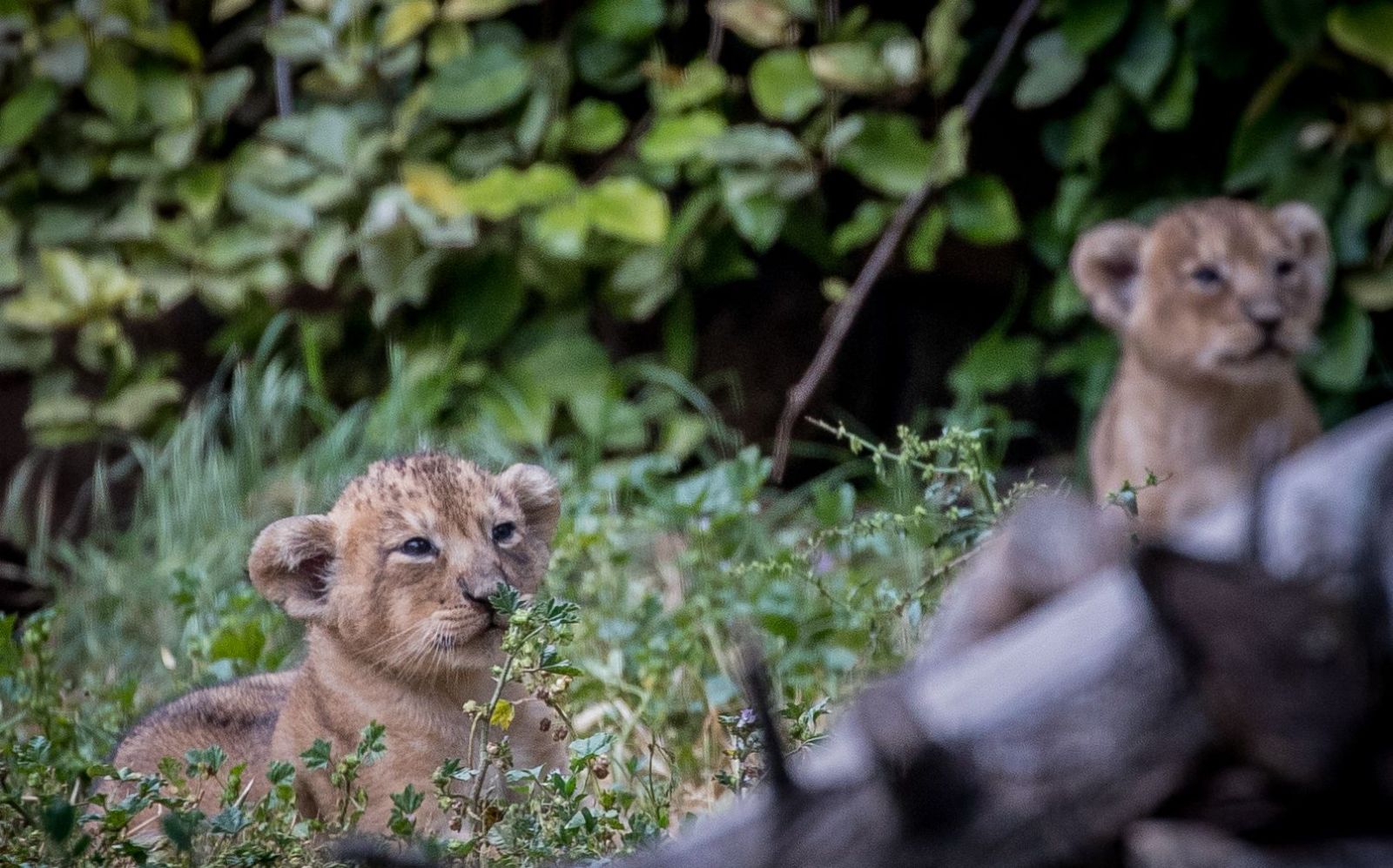
At the Jerusalem Biblical Zoo, a pair of Asiatic lions recently welcomed two cubs, the first such animals born in captivity in Israel. The cubs will soon be shown to the public now that the Jerusalem landmark is reopened.
The cubs’ proud parents are the lion Gir and the lioness Yasha, who were brought over to Israel a few years ago from Sweden and Germany, respectively, as part of the zoo’s participation in the European endangered-species breeding program.
In the past, Asiatic lions roamed freely from the Middle East all the way to India. Nowadays, only around 500 lions can be found in the wild in India, and an additional 200 are being bred in zoos across the world.
Asiatic lions are generally smaller and have a smaller mane than their more common African lion counterparts. They do, however, boast a larger tail tuft.
These two cubs at the Jerusalem Biblical Zoo are the first Asiatic lions to be born in captivity in Israel. Photo by Yonatan Sindel/Flash90
The names and the genders of the new cubs in Jerusalem are still unknown. They are presently spending quality time alone with their mother, as they would in the wild, although their father is getting a chance to know them as well.
In a Facebook post announcing the cubs’ arrival, the zoo asked that visitors help keep them safe by not coming too close and by keeping noise levels down.
Over 50 per cent of the country’s lion population currently lives outside a protected area.
These lions can navigate market places at night, find carcasses at gaushalas, avoid humans, and more.
Researchers believe that a holistic approach to conservation is necessary in the long run, one that considers human development alongside lion conservation.
India’s lion census, supposed to be conducted in the first week of May, has been deferred because of the COVID-19 pandemic. But there is little doubt that the number of Asiatic lions in Gujarat has risen since the last count in 2015. Over 50 percent of the country’s lion population currently lives outside a protected area (PA).
Wildlife experts have emphasised that it’s unrealistic to expect free-ranging lions to ‘adjust’ and live together in a small space. Since the protected area is at maximum capacity, it’s only natural that they wander farther in search of territory. How then should humans deal with the increasing population of an endangered carnivore that needs almost 10 kg of meat every day? Do we suspend human development in the name of conservation; should we expect them to live in harmony with us in our high-rise apartments?
With a different take on harmonious coexistence, Stotra Chakrabarti, Post-Doctoral Research Associate, University of Minnesota, says, “It is not easy to live with a large carnivore in your backyard. Coexistence can vary from tolerance to co-occurrence with grudges.” He mentions that according to the 2015 lion census, the lion population grew by 126 percent outside the Gir Protected Area, concurrent to around a 19 percent growth in human population in Gujarat. A consistent growth in lion population would have serious implications for humans and lions, and the efforts to conserve the latter.
Researchers say that a holistic approach to conservation is necessary in the long run, one that considers human development alongside lion conservation. Wildlife biologist Ravi Chellam, CEO, Metastring Foundation, says, “Carnivores like lions and tigers can’t live in multi-storeyed apartments; they need habitat. Lions can’t be a part of the city and village landscapes. It’s easy to say ‘these people like lions’ but lions are large, dangerous animals. They need 8-10 kg of meat a day. Where are they going to get it?” The current answer: livestock.
Lions on the road in Amreli, Gujarat. Over 50 percent of the country’s lion population currently lives outside a protected area. Photo by Stotra Chakrabarti.
The lion’s dependence on livestock
Is letting lions prey on livestock a permanent solution? While Gujarat has enough livestock to go around, a recent report by the Wildlife Institute of India (WII) shows that the number of villages where lions kill livestock is increasing by about 100 each year. If compensation isn’t revised regularly and its distribution isn’t as prompt as it is now, pastoral farmers will suffer severe losses and may not be as tolerant of lions anymore.
While humans currently coexist with lions, increased interaction between the two could be detrimental to conservation efforts. Research shows that lions outside the protected areas (PAs) have a learnt behaviour towards humans. They can navigate market places at night, find carcasses at gaushalas (cow shelters), avoid humans, and more. The tendency to just scavenge can be particularly detrimental as some cubs may not learn how to hunt because they have access to a steady stream of readily available carcasses. Chellam, who has done in-depth research on the Asiatic lions, adds, “The threats from diseases increase drastically when lions scavenge on livestock carcasses which may have died from disease. Dogs also tend to feed on these carcasses and if they carry any infections, they can transmit them to lions.”
Chakrabarti, who has spent seven years doing fieldwork at Gir, explains that lions prey on livestock because forest patches that can support wild ungulates are too few in human-dominated landscape and livestock is the most readily available prey “This brings them in direct conflict with humans and their property. The study by the WII shows that lionesses in human-dominated landscapes need a minimum of 4 sq km of sacrosanct forest patch to rear cubs in concealment. So, for long-term persistence of lions in this landscape, it is imperative to safeguard such forest patches.”
He suggests creating more lion-safe areas, if not protected areas. “The WII’s Lion Ecology Project has delineated these patches, and some sort of legal protection should be immediately bestowed on them so that they do not get converted to agricultural land or development zones.”
Lionesses with a cattle kill. Photo by Stotra Chakrabarti.
Conservation that keeps humans in mind
Conservation has to keep both humans and wildlife in mind, indicates Chellam who says that conservation strategies can’t solely focus on a particular species as they don’t live in a vacuum. “If you don’t conserve and manage the entire habitat, conservation efforts are bound to fail.”
Talking about maintaining the lion’s habitat, Chakrabarti says, “Linear infrastructure, like roads and railways, in particular, should be carefully planned or diverted so that they do not intersect important habitat patches and corridors. However, building roads and railways cannot always be compromised. In such cases, underpasses should be considered.”
Asiatic lions, unlike their African counterparts, don’t view humans as immediate threats. Researchers have observed that unless provoked, starving, or approached when with cubs or while mating (in which case they tend to be more aggressive than usual), they avoid humans. This behaviour, they theorise, is a result of being nurtured by humans.
In the early 20th century, there were but a dozen lions left due to drought and excessive hunting before the then Nawab of Junagadh stepped in and decided to protect them. As a result, their numbers have risen over the years. This relationship, while astounding, is now heavily romanticised. There is no guarantee that the big cats will not hunt humans, especially if their population continues to increase in limited space.
Yadvendradev Jhala, Dean, WII, says, “The lion population is expanding to areas where they were extirpated hundreds of years ago. In these areas, people do not have the cultural tradition of living with large carnivores. The lion density is low in the larger Saurashtra landscape right now, but if this increases, livestock kills and injuries to and death of humans will increase, and people will no longer remain tolerant. Retaliation by humans will eliminate lions from the landscape.”
Mainly found in Junagadh, Amreli, Gir Somnath and Bhavnagar districts, the lions can now be spotted in at least four other districts. Chakrabarti says that coexisting is inevitable if the population keeps increasing. “It is important that sensitisation and outreach are properly done so that people learn how to share space with them. Small changes in lifestyle can reduce interaction and conflict. Lions in this landscape provide an excellent opportunity to enhance livelihoods of locals by being adopted as wildlife trackers,vanyaprani mitras, and also through tourism.”
Standing orders for plans to relocate the lions
Another problem of having lions in a human-dominated landscape is their close interaction with feral dogs and cats. “A Canine Distemper outbreak killed over 20 lions in 2018. Feral dogs act as reservoirs for this virus and can have deadly consequences, in epidemic proportions, if the disease spreads among wild carnivores like lions. Feral dog and cat populations need to be kept in check/vaccinated to thwart disease spillovers,” says Chakrabarti.
An epidemic or natural calamity could potentially wipe out the endangered species, which is why Chellam worked on the translocation project for the lions since the 1990s. It’s another thing that the plan to move some of the lions to Kuno Palpur wildlife sanctuary in Madhya Pradesh is unable to cross bureaucratic walls. There is a standing order by the Supreme Court dated April 15, 2013 saying the translocation be completed in six months.
Jhala’s stance on relocation and conservation is slightly different, “The only secure area for lions is Gir PA. There, only 250 sq km is exclusively for wilderness and lions (the national park). We have people and livestock sharing space with lions in the remaining 1,200 sq km of the Gir sanctuary. So, in the entire world, there is only 250 sq km for Asiatic lions! Kuno, on the other hand, has freed 700 sq km of people and livestock for lions to be reintroduced there.
“The higher the lion populations in national parks and larger the parks, the safer the lions will be. If Gujarat doesn’t want to give lions to MP, they should create a 1,000 sq km national park in Gir for lions. And introduce a lion population in Barda after resettlement of all villages from inside Barda wildlife sanctuary,” he added.
Chellam is of the opinion that India tends to separate people from wildlife. “Let’s assume that’s an acceptable strategy. You can do it within a PA. How will you do it outside? Are you going to throw everyone out?” Now, those who were thrown out of PAs, in the name of conservation, are wondering why the animals are also out with them. “You can’t separate our legal framework from conservation efforts. That recognition has to come. Conservation has to be humane and just. It cannot undermine the dignity and constitutional rights of large sections of our society.”
Cubs playing at a temple in Savarkundla, Amreli district. Photo by Stotra Chakrabarti. https://india.mongabay.com/2020/05/coexisting-with-an-increasing-number-of-asiatic-lions/MAY 2020
Nature teaches us lessons to respect all life forms, live harmoniously and use the natural resources judiciously for sustainability
Are we, Homo sapiens, the only creation in isolation dominating alone the mother planet? The sane reply is: definitely not. We share it with numerous other organisms, creatures or life forms in our earnest attempt to sustain our own life. We coexist with an estimated 100 million species. The harmonious balance in sharing with all other creatures is what makes a healthy and sustainable environment.
In recent history of mankind probably there may not have been a more apt or compelling time other than the one through which we are passing currently prompting us to ponder much thoughtfully than ever over the realisation as how a healthy and harmonious environment is pivotal to sustain life on Earth. The whole humanity, reeling under self imposed lockdown, has introspected over the vulnerability and fragility of our species to doom as a result of self created environmental aberrations.
Nature teaches us lessons to respect all life forms, live harmoniously and use the natural resources judiciously for sustainability. The numerous life forms: plants, animals, insects, birds and other organism may be terrestrial, aquatic or marine, along with ecosystems and ecological services in immense natural variety and genetically diversity is what collectively is referred to as biological diversity or biodiversity. This biological diversity is the index of health of our ecosystem or environment.
Planet Earth has experienced five big mass extinctions since 444 million years ago as the experts believe and they further suspect that the planet is passing through the sixth major mass extinction. Science and our traditional wisdom have vehemently been alarming us about the disproportionate loss of our biodiversity in recent times. Disproportionate, in a sense that the rate of loss of species has, of late, exponentially accelerated due to anthropogenic activities and over indulgence. It is now believed that species are disappearing at a rate 1000 times faster than the natural rate. The biological diversity loss is leading to unhealthy environment and spread of pandemics like the one we are facing today. The solutions are nowhere else, they are in nature.
Dodo, a pigeon like bird, Passenger pigeon, Pink-headed duck, Himalayan or mountain Quail, Sumatran rhinoceros are a few amongst the hundreds of species who bore the brunt of human negligence and callousness and have gone extinct in recent past: thanks to poaching, habitat destruction and fragmentation, pollution and many other lethal activities inflicted by us.
While reflecting closely on instances of our indigenous species we horribly realise the magnitude of depletion of a large number of them. Asiatic cheetah, Pink-headed duck, Himalayan or Mountain quail, Sunderban dwarf rhinoceros have gone extinct in our country. Asiatic lion, now just a few hundred confined to Gir forest in Gujarat, Royal Bengal tiger, although reported to have shown bounced back slightly in latest census, Kashmir stag or hangul, Manipur dancing deer, pigmy hog , Lion-tailed macaque, Golden langur, great Indian bustard, Jerdon’s courser, Ganges shark, Ganges river dolphin, bush frogs, white-rumped vulture, Sociable lapwing are glaring example of species advancing on the way to oblivion unless some charismatic efforts could reverse the trend.
In Jammu & Kashmir and Ladakh landscapes many species have been drawing attention towards our minding the business more seriously. 20 species of plants and 10 species of animals & birds have been notified as species on the verge of extinction in erstwhile J&K state in 2018 under the Biological Diversity Act 2002. Hangul or Kashmir stag, for instance, a deer species with relic population, now almost confined to a small patch of Himalayan forest in and around Dachigam National park in Kashmir, is alarmingly approaching towards decimation and is notified in 2018 as species on the verge of extinction under the Biological Diversity Act 2002. This cousin of European red deer, now considered as a separate species, is currently confined to a limited distribution in Kashmir only. Many anthropogenic activities detrimental to the survival of this species including unabated mushrooming of cement factories and stone queries in the close vicinity of it’s habitat have been nullifying the conservation efforts being put in for more than half a century resulting in a cumulative sharp decline.
Unabated tourism influx in recent years and other anthropogenic disturbance in sensitive habitats of Ladakh landscape have posed threats to breeding and survival of black-necked cranes, marmots, migratory waterfowl, and snow leopard. Species like lynx, Tibetan antelope, Tibetan gazelle, Tibetan wolf, Tibetan wild ass and many more are to be watched out in this cold desert plateau.
Countries rich in biological diversity are known as mega biodiversity countries and there are seventeen of them recognized so far and India, with 10 bio geographic regions, is one of them. Further, of the 35 Global Biodiversity Hot spots 4 are located in India in addition to seven Natural Heritage Sites. Our country is privileged to have been host to 7.6 percent of world’s mammalian species, 12.6 percent of all avian species, 6.2 percent of Earth’s reptilian species, 4.4 percent of world’s amphibians, 11.7 percent of all fishes and 11.5 percent of all floral species of the world thereby gaining mega biodiversity status.
National Wildlife Action Plan 2017-2031 lays emphasis on biodiversity and habitat conservation. Biodiversity conservation in India owes a great deal to wildlife Protected Area network covering about 4.93 percent of total geographical, terrestrial, area in the form of about 544 wildlife sanctuaries, 104 National Parks 77 Conservation Reserves and 46 Community Reserves in addition to about 465 IBAs (Important Bird Areas), 18 Biodiversity Reserves, and landscape level conservation outside Protected Areas.
An estimated rural population of 275 million in India draws its resources like food, livelihood, and water from forests and depends upon them for many eco services. Loss of biodiversity, among other factors, is mainly attributed to habitat fragmentation, spread of invasive species, illegal wildlife trade, over harvesting poaching, conversion of forest land, over grazing, shifting cultivation, infrastructure development, mining and forest fires. This loss results in to catastrophic consequences including climate change, global warming, bringing disease and pandemic situations
Realizing the concerns of safeguarding biological diversity the nations of world signed the United Nations Convention on Biological Diversity at Rio de Janeiro in June 1992, India being one of the signatories. To enforce and implement the objectives of this convention India enacted Biological Diversity Act 2002. The Act provides for the conservation of biological diversity, sustainable use of its components and fair and equitable sharing of the benefits arising out of utilization of genetic resources. The Act lays emphasis on documentation of traditional and contemporary knowledge about our natural resources and their use in our culture. Strengthening Biodiversity Management Committees (BMCs) and preparation of Peoples Biodiversity Registers (PBRs) at grass root level, involving gram Panchayats and local bodies, will help a great deal in conservation, documentation and sustainable benefit sharing of biological resources.
The author is recipient of Sanctuary Wildlife Service Award and writes on conservation issues. He is presently Joint Director, Jammu & Kashmir Forest Research Institute (JKSFRI).
National Endangered Species Day is celebrated each year on the third Friday of May across the country to raise awareness about the endangered species of flora and fauna. This day helps us review how many animal species are under the threat of extinction and how the drastic effects of climate change are disturbing the once peaceful ecosystem.
This day gives us the opportunity to be more aware about the conservation of endangered species and learn about the different steps the country is taking to properly protect these animals. Due to the ongoing coronavirus pandemic, this year, National Endangered Species Day will be celebrated through online campaigns and events.
On National Endangered Species Day 2020, here are 7 endangered animal species are endangered in India-
Photo Credits- Wikipedia
1. Asiatic Lion
The Asiatic Lion is one of the mightiest species of lion in the world. The entire population of the species can now only be found in India and is now restricted to Gir National Park and environs in Gujarat. The IUCN Red List has declared the animal endangered because of the constant decrease of its population since 2010. The total number of Asiatic Lions left in the country are now just 650.
Photo Credits- AFP
2. Bengal Tiger
Referred to as the ‘Big Cat’ in our country, the Bengal Tiger has 70 percent of its overall population living in India. Due to the rigorous poaching instances in India, the species become endangered in the last 4 years. Corbett National Park has a large number of Bengal Tigers currently, though the overall number of these tigers in India are down to around 2000.
ADVERTISEMENT
Photo Credits- britannica.com
3. Snow Leopard
The snow leopard is a large cat which used to be found in large numbers in the mountain ranges of Asia, but because of constant human interference in their natural environment, the number of snow leopards have dropped down to almost 500. These cats can now be spotted only in Ladakh, Himachal Pradesh, Uttarakhand and the western and eastern parts of the Himalayas.
Photo Credits- Wikipedia
4. Nilgiri Tahr
The Nilgiri Tahr is an endangered mountain goat species, which is now found in some areas of Kerala. The species became endangered due to continuous poaching and lack of natural habitats for them. They are considered as the state animal of Tamil Nadu but are now having troubling finding a home in the state. There are around 2500 Nilgiri Tahrs left in the world now and their numbers remain decreasing due to harmful human activities.
Photo Credits- Reddit
5. Kashmiri Red Stag
The Kashmiri Red Stag is also known as Hangul, and have been critically endangered for decades. The animal is found in dense riverine forests of the high valleys in Kashmir and Himachal Pradesh. The number of Kashmiri red stags had fallen as low as 150 in 1970 but since then, there have been many conservation drives conducted to protect this critically endangered species in our country.
Photo Credits- Britannica
6. Blackbuck
The blackbuck is also known as the Indian antelope and in found in several regions of India, Nepal and Pakistan. The species has also been declared extinct in Bangladesh and is now endangered in India due to heavy poaching and tampering of its natural environment. The blackbuck can now only be seen in small herds in the country, but as a conservative measure, it has been introduced in Argentina and the United States to increase their number.
Photo Credits- savetherhino.org
7. One- horned rhinoceros
The one horned rhino is also called the Indian rhinoceros and is listed as a vulnerable species by the IUCN. The animal is mostly found in the foothills of Himalayas, in India and in Nepal. They are usually poached for their horns, which allegedly have medicinal properties. Due to constant poaching, the numbers have decreased over time, with now more than 2000 such rhinos remaining in the wild. Now they are being conserved in several wildlife sanctuaries and parks in the nation. https://www.indiatoday.in/education-today/gk-current-affairs/story/national-endangered-species-day-2020-here-are-7-endangered-animal-species-in-india-1678339-2020-05-15