English language news articles from year 2007 plus find out everything about Asiatic Lion and Gir Forest. Latest News, Useful Articles, Links, Photos, Video Clips and Gujarati News of Gir Wildlife Sanctuary (Geer / Gir Forest - Home of Critically Endangered Species Asiatic Lion; Gir Lion; Panthera Leo Persica ; Indian Lion (Local Name 'SAVAJ' / 'SINH' / 'VANRAJ') located in South-Western Gujarat, State of INDIA), Big Cats, Wildlife, Conservation and Environment.
The Gujarat high court has rejected the bail application of Elyasbhai
Hoth, who is accused of baiting lions in the Gir sanctuary. Hoth, a
settler was arrested under various provisions of the Wildlife
(Protection) Act 1972 after videos of him baiting lions with poultry
went viral. The matter came to the high court after his bail was
rejected by the trial court.
The court while rejecting the application said that after the
charge-sheet is filed, the punishment prescribed under the law is of
seven years, the court is required to consider the request of regular
bail.
It also said that the accused had sought bail seeking parity with
the co-accused in the case who had already been given bail. There were
not only oral evidence but electronic evidence against the accused.
The counsel for the applicant had sought bails on the ground that
since the trial in the case was not likely to be over in the matter soon
he should be granted bail. He further argued that there were many
others who had indulged in similar activity but no action was taken
against them.
Opposing the application, the state argued that Asiatic lions were
protected species under the Schedule I of the Wildlife Act and Hoth was
the kingpin in the case. The others who had been bailed out had very
limited role to play in the incident.
The state argued that Hoth had been indulging in such things for
quite some time as he had been allotted land near the sanctuary under
Tribal Settlement Act had he missed this. They also argued that video
recording evidence of the act was also available.
It said apart from baiting the animals, the video recordings also
show the presence of liquor bottles and other prohibited items which are
completely banned in the Gir Sanctuary.
With the ever increasing love of travel and
adventure, more and more Indians are now opting for vacations in and
outside the country. While some choose locations to relax and take a
break from their fast lives, others want to see new things, meet new
people, and try different cuisines. There’s another lot, the ones who
have an unquenching thirst for adventure.
No matter the kind of vacation you are looking for, coming back with
some memorable photographs is a must in every case. But when it comes to
wildlife safaris, people enter the forest reserves with high hopes of
spotting a tiger or a leopard, but often leave with disappointing having
seen none. Many call it luck, while others don’t go on safari tours in
the right time for spotting a big cat.
Solving this problem is WildTrails, a smartphone application which
gives details of sightings of all species (not just tigers), across most
of the top national parks and reserves in India.
This app gives complete details of sightings of all species through
data mining. After data analytics on these sightings they come up with a
Sighting Index metric which can predict well on what the chances are of
sighting a particular species in a given sanctuary for a given zone
during a given time period. This process will greatly enhance one’s
sighting probability. The app also reveals where and how recently big
cats were spotted in various parks in India.
Manjunath Gowda, the CEO of WildTrails, says, “The number of people
interested in wildlife tours looking for big cats has increased
drastically over the last few months. More so for the tiger and the
black panther and of course, most want to know which is the right
sanctuary to visit and how are the sightings in those respective parks.
WildTrails wildlife holiday app fulfills this customer need by analysing
sightings data that is gathered every day. We end up calculating the
Sighting Index (R) of a given species over a given period of time which
gives a good sense of which park, which zone to go to while looking for
these big cats. Of course, we also book the right trips using this
data.”
While most Indians know that the Bengal tiger is the national animal
of India what is less well known is that besides the Bengal tiger, India
is also home to a number of other species of big cats — Asiatic lion,
Indian leopard, snow leopard, and the Clouded leopard and some more.
However, these five species of big cats are relatively easy to see in
the 50 tiger reserves in India, yet many in India have gone on several
wildlife safaris without seeing even one big cat.
The most elusive big cats are snow leopards and clouded leopards.
While snow Leopards can be seen in the Himalayan mountains, specifically
in Ladakh and Dachigam in Kashmir, to spot a clouded leopard one must
visit the forests of the northeast such as Manas and Buxa. Despite the
remoteness of these regions, the Wildtrails app claims to be a helpful
companion that can increase the likelihood of seeing these most elusive
of big cats.
“If the sightings of the wild animals is made sure, then of course it
will be easier for a photographer to shoot pictures. Photographers wait
days and nights to capture a perfect shot, it will also save money.
But, however, it’ll also take away the thrill and anticipation from
wildlife photography,” opines Ujjal Debnath, a professional
photographer, upon about the application.
Those with the knowledge of wildlife have said that for every big cat
a person sees, 10 big cats see the person without being spotted! https://dbpost.com/look-before-you-book-this-app-helps-you-spot-tigers-during-safari-tours/
Lions and leopards aren't exactly best of friends.
They often fight over food and territory often killing or severely
injuring each other.
So,
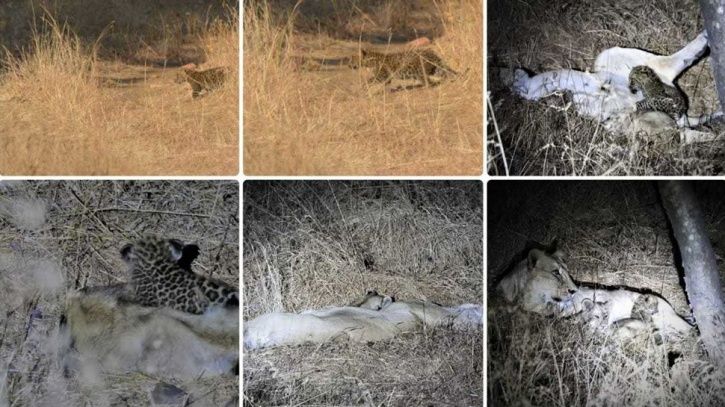
it was quite shocking for the forest officials to know that a lioness,
Raksha was nursing a 2-month-old leopard cub named as Mowgli, in Gir Forest. It is not clear how the lioness came across the cub or where the mother of the leopard baby is.
Usually,
if a lion or a lioness finds a leopard or leopard cubs, they instantly
kill them. But, for this lioness, motherly instinct seems to have
overtaken the killer instinct because she adopted the baby into her
clan.
After
observing the behaviour of the lioness, the foresters started sharing
pictures and videos of the lioness feeding and nurturing the cub.
Don't Miss
Interestingly, the lioness is extra protective about the cub, Deputy Conservator of Forests Dheeraj Mittal said.
"Since
the leopard is smaller than her cubs, she ensures it walks ahead. She
stops and waits for it to come closer to her when moving around or if
they are near a water body," he added.
The lion family has also accepted the leopard baby, the lion cubs are quite fond of their younger brother. Foresters
said, "This arrangement is extremely unusual. So, we have decided to
observe the dynamics without intervening in any way." https://www.indiatimes.com/trending/environment/motherly-instinct-trumps-killer-instinct-lioness-in-gir-forest-adopts-nurses-a-leopard-cub-359824.html
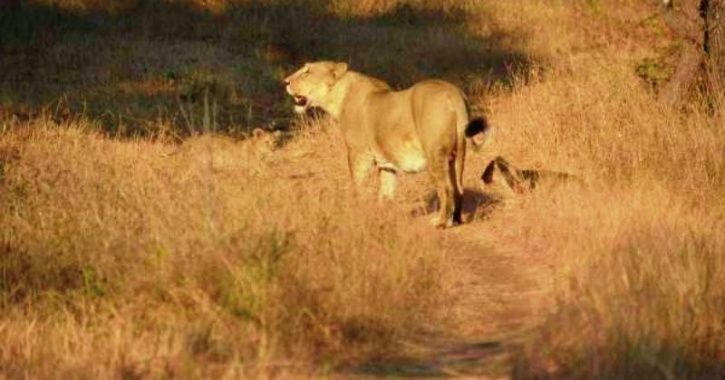
A lioness in Gujarat’s Gir Forest has adopted a one-and-half-month
old leopard cub who has been separated from his mother. The Gujarat
forest officials are claiming this to be a "rare phenomenon".
The lioness is looking well after the cub and is also protecting him from other lions who might try to kill him.
“Along
with two of its own cubs, the lioness, spotted in the forests of
Gir-West division, is feeding the leopard cub,” says a report by PTI.
The forest staff spotted the lioness with the leopard cub some six days ago.
Don't Miss
"It
is indeed a rare phenomenon, as lions tend to kill leopards. In this
case, it is quite opposite to what we know about big cats. The lioness
is taking extra care of a leopard cub. The lioness is even protecting it
from lions present in the area," Deputy Conservator of Forest, Gir-West
division Dheeraj Mittal told PTI. https://www.indiatimes.com/news/india/unusual-bonding-as-gir-lioness-adopts-a-leopard-cub-separated-from-mother-in-a-rare-phenomenon-359853.html
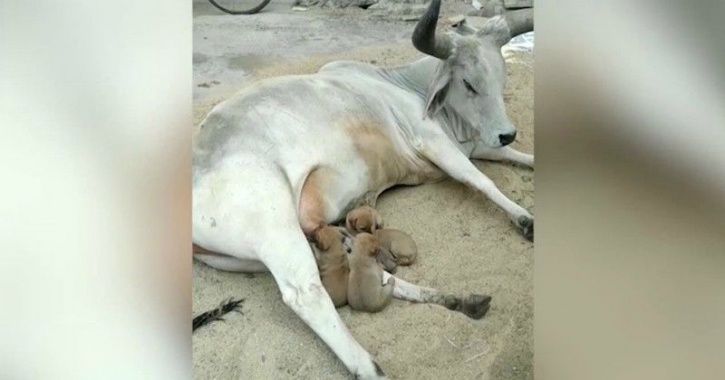
There are a few heart winning images that make your weekend perfect. A
video of a cow feeding four orphaned puppies is being shared widely and
calming the senses of the people.
The
short video was recorded by the bystander who couldn’t help capturing
the emotional sight before him. A couple of days, the news of a lioness
adopting leopard cub had touched our hearts.
According
to some accounts, the mother of the puppies might have died after
giving birth and the four puppies were adopted by the cow who is seen
feeding them.
The video was an instant hit on social media.
Similar videos had surfaced recently on the internet where a pet dog and
cat were seen showering each other with love. The video on twitter had
won many hearts. The two species aren’t known to be best of friends, but
this was quite unique and the six-second video shows dog Maggie gently
petting cat whose name is Pumpkin on her back. https://www.indiatimes.com/news/india/video-of-a-cow-feeding-four-orphaned-puppies-is-the-best-thing-you-can-watch-this-weekend-359876.html
Kuno National Park is a protected area in Madhya Pradesh that received the status of national park in 2018.[1] The protected area was established in 1981 as a wildlife sanctuary with an area of 344.686 km2 (133.084 sq mi) in the Sheopur and Morena districts. It was also known as Kuno-Palpur and Palpur-Kuno Wildlife Sanctuary.[2] It is part of the Kathiawar-Gir dry deciduous forestsecoregion.[3] for more... https://en.wikipedia.org/wiki/Kuno_National_Park
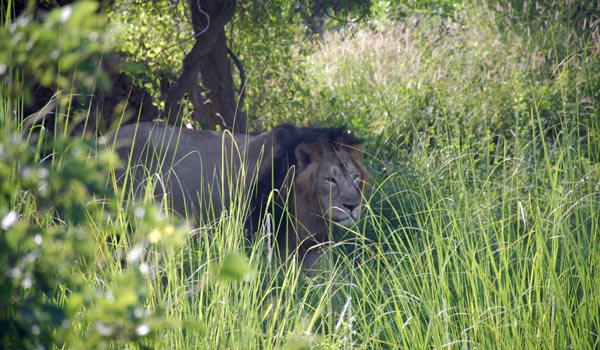
More than 8500 tourists came to see the
Asiatic lion’s family including two lions and one lioness at the park
over the last three months.
January 3, 2019 4:30 pm Jaipur: Lion Safari at Nahargarh Biological Park visited by record number of tourists in Dec
Lion at Nahargarh Biological park of Jaipur.
Jaipur: Lion safari at Nahargarh Biological Park in Jaipur recorded the highest number of tourists in December last year.
More than 8500 tourists came to see the Asiatic lion’s family
including two lions and one lioness at the park over the last three
months.
The Lion Safari at Nahargarh Biological Park started on October 3, 2018. A total of 1548 tourists visited the park in October followed by 2770 in November and 4475 in December.
Meanwhile, the biological park saw a rapid increase in the number of
tourists from December 21 to December 31, 2018. Around 459 tourists
visited the park during the last 10 days of 2018.
According to a senior park official, around 52360 tourists visited
the park in the 2017 and a total of 57919 tourists visited the park in
2018. As compared to 2017, the number of tourists visiting Nahargarh
Biological Park increased by 5559 last year.
The officials said that the reason for this increase could be the introduction of Lion Safari project.
According to the ACF of Nahargarh biological park Jagdeesh Gupta, the
park’s popularity has increased among local as well as foreign tourists.
An Asiatic lioness at the Prague zoo underwent artificial
insemination in the zoo's latest attempt to breed the lions since 2015
After two suitors failed to get a rare
Asiatic lioness pregnant, Prague zoo now hopes that artificial
insemination will finally plant the seed for her species' survival.
"Ginni, our female Asiatic lion from Gujarat in India, underwent artificial insemination on Wednesday evening," the zoo said in a statement on Thursday.
With some 600 Asiatic lions living in Gujarat and another 143 in
European facilities, zoo director Miroslav Bobek said he held "great
hope" in Prague's Asiatic lions to preserve the dwindling species on a
global scale.
The zoo has been attempting to breed its three Asiatic lions from India since they arrived in 2015, so far with no success.
Female Suchi proved to be sterile while Ginni repeatedly snubbed her nose at Jamvan, a male who zookeepers say was too passive.
Sohan, another male borrowed from a zoo in the eastern Czech city of
Ostrava, also failed to get Ginni pregnant but did manage to trigger
ovulation.
In the end, zookeepers opted to use Jamvan's sperm to inseminate
Ginni during Wednesday's procedure, which, if successful, should see
cubs born in about four months.
The procedure was carried out by a team from the Berlin-based Leibniz
Institute for Zoo and Wildlife Research and Prague zoo vets.
They pegged the probability of success at 60-70 percent.
Last autumn, authorities in Gujarat reported dozens of dead Asiatic
lions, killed by the canine distemper virus and a parasitic infection
caused by ticks.
https://phys.org/news/2019-01-prague-zoo-rare-lion-insemination.html