Wednesday, October 31, 2018

A peaceful living for the leopard


|

A peaceful living for the leopard Amid the sorrowful story of the two super cats — the Asiatic Lion and Royal Bengal Tiger — is the story of the smartest big cat, the Indian leopard, which is on the path to re-capturing its lost habitats...
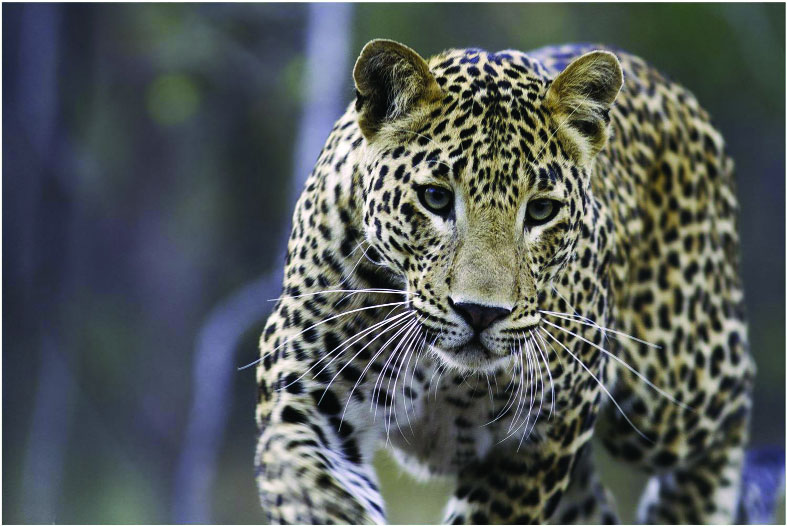
The two super cats, the Asiatic lion and the Royal Bengal tiger, drew the maximum attention of conservationists in India. But the third largest cat, the Indian leopard, has its own story under the shadow of its two big tribes. Two recent stories — one, the death of 23 lions in Gir due to CDV and Protozoa infections and second, the hunt for a man-eating tiger in Maharashtra  — grabbed headlines in Indian newspapers and electronic media.
But this story is about the smartest big cat — the Indian leopard (Panthera pardus fusca), a sub-species of the nine subspecies of all leopards in the world. It is widely distributed across the country — from Jammu & Kashmir in the north-west to the southern part of Tibet in China in the north-east Himalayas to Cape Comorin in the south and from the Gir forest (Saurashtra) and thorn forest in the arid zone of Kachchh in the west to the moist forest of Myanmar in the eastern border of India.
Although a majority of the leopards are confined in India, small populations are also found in Nepal, Bhutan, Bangladesh, Myanmar, Pakistan and small areas of southern China adjoining Myanmar. Each of the other seven sub-species of the Asian leopard has a small population, below one thousand, in different Asian countries.  After the African leopard, only the Indian leopard has a viable population. The Indian leopard occurs up to a height of about 5,200 meters in the Himalayas where their habitat meets the lower altitude of the snow leopard.  A study revealed that the distribution range of the Indian leopard reduced to 28 per cent of its historical distribution range, although the big cat enjoys the highest protection level in our country as it is placed in Schedule-I of the Wildlife Protection Act, 1972.
According to an article published in the Indian Forester in January 1907, a total of 811 leopards and 1,355 tigers were officially killed in 1905 to reduce their menace. Level of killing in the preceding year (1904) was also at the same level. Thus, about 800 to 900 leopards were killed annually in the beginning of the 20th century which increased subsequently later.
It was also mentioned that leopards killed 401 human beings and 44,845 livestock in 1905. Hunting licenses were issued freely to kill wild animals, including leopards. A total of 37,720 hunting licences in 1904 and 37,833 in 1905 were issued in India.  As per records, 150,000 leopards were hunted in British India during a span of 50 years (1875-1925) at an annual rate of 3,000 leopards. It was estimated that 100 years ago, India had over 10 times the present population of the tiger.  By extending similar logic and studying hunting records, it can be said that the Indian forests had a high population of the leopard before the Second World War. Thereafter, they were killed in thousands, which pushed them to become near extinct. However, conservation measures have reversed the trend.
Distribution range:  In a majority of the Indian States, the leopards are dispersing in new areas due to which its population is recovering. Until a few years ago, Punjab was considered to be a non-tiger State as the animal occasionally visited in the winter from the hills of Himachal Pradesh. But in recent times, the Leopards have made a come back in the lower Shivalik hills of Punjab,  bordering Himachal Pradesh.
Similarly, about two and a half dozen of leopards marked their presence in the Shivalik of Haryana a decade ago. The animal dispersed from the Shivalik of Himachal Pradesh and from the Aravallis hill ranges of Rajasthan to the forests of Haryana. At present, forests in 10 districts in Shivalik and the Aravallis of Haryana have been captured by the leopards in good numbers.
At present, the Indian leopard is distributed in 29 States and one Union Territory.  Uttarakhand, Gujarat, Madhya Pradesh, Karnataka, Chhattisgarh, Maharashtra, Rajasthan and Himachal Pradesh have over two-thirds of the total leopard population of the country. In the 1990s, the leopard’s presence was recorded in 196 sanctuaries and national parks across 26 States of the country.
Since then, the number of States and protected areas has increased and expanded. As per latest reports, the animal’s presence has been registered from 384 national parks and wildlife sanctuaries across the country, although few other protected areas are seasonally or occasionally visited by the leopard.
Area of these leopard supporting national parks and wildlife sanctuaries is about 136,550 km. Of this, about 50 tiger reserves and their buffer zones in 17 States are occupied by the Tigers and five national parks and wildlife sanctuaries in Gujarat by the Asiatic lion. In the rest of the leopard supporting protected areas, the leopard is a top predator but compete with the hyena.  Experts believe that though the sanctuaries and national parks accommodate a good number of the animal, a large number of them are found outside these boundaries than those within, and some are using non-forest areas, including scrublands, tea garden, ravines, sugarcane fields and another vegetation cover.
In the State of Gujarat, as per the leopard census report in 2011, about 38.2 per cent of the leopard population was counted in the protected areas, 18.0 per cent in the sugarcane field, agricultural lands, plantations and ravines, and the rest in the forest areas beyond the boundaries of the protected areas. Leopard population in protected areas of Uttarakhand, Maharashtra and Odisha were about 25.2 per cent, 44.1 per cent and 35.3 per cent respectively.  An analysis of data from 12 major leopard States reveals that about one-third of the total leopards were found in national parks and wildlife sanctuaries. Also, based on census reports of a few States, about 15 per cent of the leopards used habitat beyond the boundaries of the forests.
Leopard’s occupancy in the major part of 14 tiger States was 173,900 km in 2014. As per the rough leopard distribution range, provided by the Chief Wildlife Wardens and wildlife experts in the States, the leopards occupy about 114,000 km in other 15 States and Union Territories. Thus, the leopards occupy over 287,900 km forest areas of the country.
Tea gardens have become a major man-leopard conflict zone because a good number of them breed and hunt in these areas. At least 5,670 km area of the hilly terrain or slopes in Nilgiri hills (Tamil Nadu, Kerala and Karnataka), Darjeeling hills, drained land of Dooars and Terrai down the hills in West Bengal and moderate hills and slopes in Assam and other such lands in the North- East States, Uttarakhand and Himachal are under tea cultivation. Presence of leopard and human-leopard conflict in these tea gardens have been recorded for over 100 years. Most of these areas form contiguous leopard habitat with the adjoining forests.
Recently, maximum human-leopard conflicts were recorded in and around the sugarcane fields in some States. Sugarcane cultivation has expanded with the expansion of irrigation network. The adaptive big cat has successfully exploited the dense sugarcane crop for littering. During the last five years, the extent of sugarcane cultivation in India ranged from 44,360 Km to 50,670 km. Leopards are frequently seen in the sugarcane fields. Majority of such dense tall crops in the four States — Maharashtra, Karnataka, Gujarat and Tamil Nadu, which cover about 31.9 per cent of the sugarcane cultivation area in the country — are inflicted by the leopard. The animal is also seen in the sugarcane fields in Terai belt in Uttar Pradesh and Bihar.
A recent paper, ‘Big Cat in Our Backyards’, published by the journal ‘Public Library of Science’, made headlines by reporting up to six resident leopards per 100 km in the sugarcane fields in Sangamner region of Maharashtra. The big cats hide in the dense cover of sugarcane crops during the day, preying on dogs, pigs, cattle and poultry in the night in the villages and towns. When one or two leopards killed five people in Mandvi Taluka of Surat district, Gujarat in the post-monsoon and early winter in 2010, while hunting and trapping the man-eater, about two dozen leopards, including cubs, were eliminated from the sugarcane areas of the villages in three months. When a leopard killed four people in sugarcane zone in Veraval in Junagadh (Gujarat) in March 2012, a total of nine leopards were trapped and removed from the area. There are several such stories in the sugarcane belt.
The extent of forests cover with canopy density of more than 10 per cent is 683,925 sq  km in 29 States and one Union Territory which support leopards. The shrublands and ravines outside the forests also support leopards. In the leopard State, about three-fourth of the forest cover is expected to be potential habitat, although present occupancy area of the leopard is lesser than the potential habitats.  The analysis indicates that the leopard occupancy area in India may be in an extent of over 300,000 km, although potential habitat is high.
(This is the first article in a two-part series on Indian leopards. The second part will appear in these columns on Thursday, October 18.  (The writer is Member, National Board for Wild life)
https://www.dailypioneer.com/2018/columnists/a-peaceful-living-for-the-leopard.html

Forest Deptt to introduce Assam’s wild buffalo in Kanha

Source: The Hitavada      Date: 16 Oct 2018 14:38:05


By Ankita Garg,
Madhya Pradesh Forest Department gears up to re-introduce Hard Ground wild buffalo at Kanha Tiger Reserve area. Hard Ground wild buffalo has been almost extinct from the jungles of Madhya Pradesh.
To re-introduce Bison in several jungles of State, Forest Department has chalk out plan to translocate herd of Bison from Assam where they are available on large scale. National Tiger Conservation Authority (NTCA) has given its final nod for the project.
Earlier, wild buffalo was available in large number in Kanha Tiger Reserve and nearby areas but gradually they become extinct from the area.

Forest officials said, while deciding translocation of Asiatic Lion in MP, Central Government has also asked to re-introduce wild buffalo in jungles of Madhya Pradesh as they are good for the food chain of animals in forest areas. Forest Department has now started working on the project.
“We will soon bring wild buffalo from Assam to introduce them in Kanha Tiger Reserve area. It is also part of the Asiatic Lion project and we are also in need of Bison for the food chain in jungles,” said Alok Kumar, Additional Principal Chief Conservator of Forest (APCCF). He further informed that earlier there was proposal to bring nine male wild buffalo and two female buffaloes from Udanti Wildlife Sanctuary of Chhattisgarh. He said after visiting the animals, officials found that one of the female buffalo is over age and other one is younger so both of them would not be part of breeding. Concern over the need of female for breeding plan, authority has decided to bring the buffaloes from Assam.

Alok Kumar said that a team of officials are being formed to prepare the route map of translocation. The team members will be deciding entire transportation of buffaloes as they are very sensitive animals. He said, in first phase three pair of buffaloes will be brought to Kanha Tiger Reserve from Assam. They will be enclosed in a quarantine (specially made for the buffaloes) for few months. As per study, Supkhar area of Kanha is suitable for the Bison.

Alok Kumar said there is slight difference between the buffalo of Madhya Pradesh, Chhattisgarh and Assam. Bison belong to Chhattisgarh (Hard Ground) prefer to stay in grass land while Assam Buffalo prefer to stay in muddy ground. They live in water and mud for maximum time.
http://thehitavada.com/Encyc/2018/10/16/Forest-Deptt-to-introduce-Assam-s-wild-buffalo-in-Kanha.aspx

India’s policy flip flop on the lion and cheetah

 by on 16 October 2018
  • The death of 23 lions within one month is once again a warning signal for the authorities who have failed to give it a second home beyond Gir in Gujarat, despite a clear order from the Supreme Court of India.
  • While dragging its feet on the issue of lions, the government is once again seeking permission for reintroducing cheetahs in the country even when they were declared extinct in 1952.
  • Experts argue that instead of focusing on bringing cheetah back and making it a case of national pride, authorities should focus on ensuring the best care for the other endangered species in the country.
It is a tale of two large carnivores. While authorities have dragged their feet over finding another home for the lion to ensure its survival in case of unseen dangers, they have been making plans to reintroduce the cheetah, which was declared extinct from the country in the early 1950s.
In April 2013, the Supreme Court of India (SC) had directed the central government to establish a second home for the population of Asiatic lions in India but the latter failed to do so. Instead, the central government recently returned to the SC seeking permission for the reintroduction of cheetah even though the apex court rejected it earlier. The issue gains significance in light of the deaths of at least 23 lions during this month.
Environmentalists feel that there is a need to weigh whether reintroduction of the cheetah should take precedence over recovery plans for critically endangered species such as the great Indian bustard (GIB), gharial, dugong and others. They also question the wisdom of introducing another predator species in view of the high human-animal conflict across the country.
In April 2013, the SC had directed India’s Ministry of Environment, Forest and Climate Change (MoEFCC) to take urgent steps for the re-introduction of the Asiatic lion from Gir forests to Kuno Wildlife Sanctuary in Madhya Pradesh. The SC had asked the authorities to carry out the order in its “letter and spirit” within six months (by October 2013) and quashed the MoEFCC’s plan to reintroduce cheetah in India. “The order of MoEFCC to introduce African Cheetahs into Kuno cannot stand in the eye of law and the same is quashed,” SC had noted.

Lion deaths in Gir

In the last one month, at least 23 lions have died in the Gir forests in Gujarat and authorities have been citing several reasons for their death.
23 lions died in Gujarat in the last one month. Photo by Samarth V Dangre /Wikimedia Commons.
“We can’t attribute only one reason to (lion) deaths in Gir. There are multiple reasons. Few deaths are due to infighting, which is a natural phenomenon in lions. Secondly, there are indications of viral infection. We can’t attribute one reason to the deaths,” said D.T. Vasavada, chief conservator of forests, Gujarat.
“The entire Gir forests is not at risk and it is only one pocket that is affected,” Vasavada said. “All deaths are in a small area of 25 square kilometres. Right now all the effort is to save the remaining lions and screen the entire surrounding area. In the nearby area, we have rescued 31 animals and kept them under observation. They are healthy so far.”
A Gujarat government official further informed that the entire area of Gir has been screened. “We have screened the entire Gir and the surrounding areas. For this, about 140 teams were deployed involving 550 persons and this continued for about eight-nine days. At present, we have not found similar symptoms outside the affected pocket. Experts and officials from Gujarat, the Wildlife Institute of India, the environment ministry and several other national institutions have come to assist,” said the official, while wishing anonymity.
Meanwhile, samples have also been taken from the lions who died in Gir and tested.
“In another spurt of illness in Gir lions, the ICMR-National Institute of Virology (NIV), Pune received a total of 80 samples of nasal, ocular and rectal swabs from 27 Gir lions which were sick and under treatment and observation at Sakkarbaug Zoo in Junagadh, Gujarat. Specimens were again tested for Canine Distemper virus (CDV) by using molecular methods. One or more samples from 21 out of 27 Gir lions have tested positive for CDV. This indicates active disease transmission among the Gir lions,” said the Indian Council of Medical Research (ICMR) last week in a statement.
It stated that “lions should be immediately vaccinated with the available vaccine for CDV” and that “since CDV is transmitted by airborne route as well as infected body secretions, healthy lions from Gir Forest may be shifted to an alternate suitable location.”

Lions continue to wait for their second home

Even though the SC directed for it and experts advocated for Gujarat to translocate lions to Kuno in Madhya Pradesh, Gujarat has dragged its feet. Since 2013, the SC’s order has been unsuccessfully challenged several times.
“In a country where there is no compliance of an order of the Supreme Court, what is cheetah or lion? The example set by Gujarat is very dangerous. The deaths of lions have shown that even in the case of wildlife conservation, people can do anything for political interests. These deaths are certainly a warning bell,” said Ajay Dubey, who has been fighting a case in the SC on the issue.
“The commercial interest of tourism because of which Gujarat talks about the Gujarati pride is against the provisions of the constitution, according to which lions are national property and not of some region or state,” he added. Dubey informed that he would once again approach the apex court to ensure the implementation of the 2013 order.
Despite SC’s order, lions are yet to get their second home in India. Photo by Ayush Baheti/Wikimedia Commons.
The main concern of wildlife experts has been that population of lions in just one habitat in the country can be dangerous to their population in case of a danger like natural calamity or virus outbreak. The example that is often used to buttress this argument is that in 1994, lions in Serengeti (Tanzania) suffered from an outbreak of the canine distemper virus. The total population of lions in that landscape at that time was around 2,500 and the outbreak due to the virus led to deaths of hundreds of lions.
A similar incident can trigger the extinction of species in India in light of the smaller habitat and smaller population. In 2015, the lion population was pegged at 523. But in 2016 and 2017, as per Gujarat government figures, a total of 184 lions died in Gujarat. The new lion census is expected to take place early next year.

The cheetah reintroduction conundrum

The story of cheetah in India may not be similar to that of the lion, but what is similar in case of both species is the misplaced priorities. While lions are not able to move out of Gujarat due to the issue of state’s pride, cheetah reintroduction is pushed in the name of national pride.
Historically, India was home to cheetahs but according to the government they were declared extinct in 1952. It is the only large mammal that has gone extinct since India’s independence. If the cheetah is reintroduced in the country, India would become probably the only country in Asia to have all the major big cats (lions, tigers and leopards included).
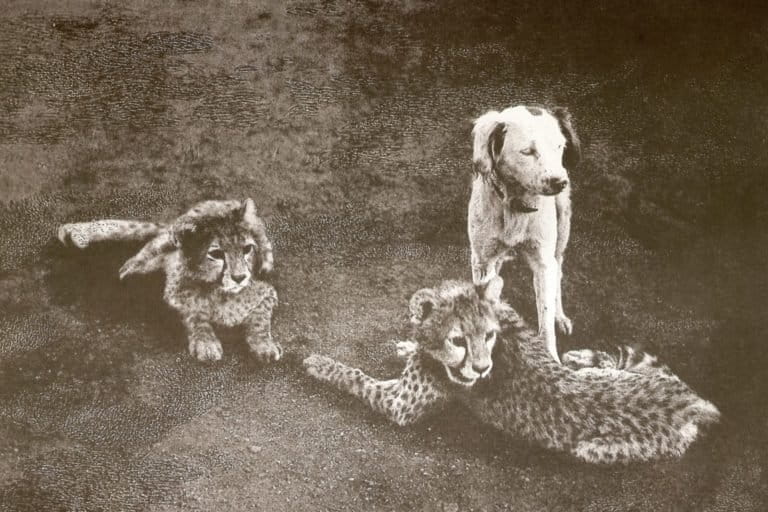
Asiatic cheetah cubs with a dog in Dharwad, Karnataka in 1897. Asiatic cheetahs were declared extinct from India in 1952. Photo by Major G.S. Rodon/Wikimedia Commons.
Reintroduction of the cheetah has always been on the cards since its extinction decades ago, but it gained serious traction during the tenure of Jairam Ramesh as India’s environment minister in 2009. It was during that period, when a detailed ‘Project Cheetah’ was envisaged on the lines of Project Tiger, which is a focused programme for ensuring the welfare of tigers in the country. But it was shelved in 2013 after SC’s order.
But five years after that order, earlier this year, the National Tiger Conservation Authority (NTCA) filed an application in the SC stating that bringing cheetah back “would have a very special significance for the national conservation ethic and ethos”.
“It would focus attention on the conservation of our neglected grasslands and our open forests just like tiger conservation has led to the protection of our forested national parks and sanctuaries. It would also enable the conservation of such gravely endangered species occurring only in grasslands and open forests, such as the wolf, desert cat, desert fox and the great Indian bustard,” said the NTCA in its application.
The NTCA stated that the reintroduction of cheetah would be a “matter of great conservation significance and pride for the country”.

Should cheetah be brought at cost of other endangered species?

In its application, the NTCA had also argued that there is very little difference between the African and Asiatic subspecies of cheetah. It, however, admitted that though the Iranian cheetah is genetically closest to cheetah that went extinct in India it is now difficult to get them from Iran due to its small population size in Iran. Therefore, it said, India will bring cheetah from southern Africa stating that it would provide “best genetic stock” and that cheetah from southern Africa are ancestral to all cheetah subspecies, including the Asiatic one.
The NTCA has also tried to dismiss another argument that cheetah reintroduction was not part of the MoEFCC’s National Wildlife Action Plan (2002-2016), stating that just because it was not mentioned in NWAP does not mean a “reintroduction programme is barred forever in future”.
Experts are not convinced with the arguments in favour of bringing cheetah to India.
“While I am not averse to the concept of re-wilding, I am not sure if there’s adequate and ideal habitat for a large-ranging carnivore such as the cheetah in India at present. If we go by the argument that cheetah will function as a mascot for grassland conservation, where in India have we got large enough grasslands that can support a long-term viable population of this species?,” said independent wildlife researcher Priya Singh, who worked on the cheetah reintroduction project in 2010-2011.
In response to NTCA’s application in the SC, advocate Ritwick Dutta filed a submission against the reintroduction of cheetah SC last week. “The issue as to whether the African cheetah should be imported into India and whether the same is an alien species is best left to be decided by scientific experts in the field in accordance with the latest scientific developments. However, there are larger conservation issues, which need to be considered before any decision is taken for the reintroduction of the cheetah. Specifically, given the limited resources (both human and financial), there is a need to have conservation priorities,” he argued.
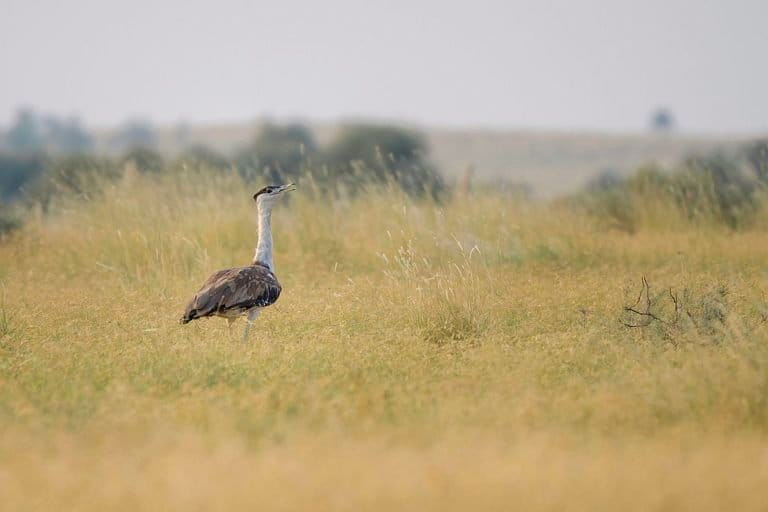
Experts want the limited resources available for other critically endangered species like GIB. Photo by Saurabhsawantphoto/Wikimedia Commons.
He also stated that there is a need to weigh whether reintroduction of cheetah should take precedence over recovery plans for critically endangered species such as the Asiatic lion, the great Indian bustard and others.
One of the major arguments of the NTCA has been that cheetah reintroduction will lead to enhanced protection of grasslands. Dutta, however, disagreed with it and submitted to SC that, “there are no reasons to presume that merely by introducing a charismatic species such as cheetah the grasslands will be protected.”
The path to reintroduce cheetah in India may not be easy for the government as a recent news report revealed that an SC-appointed panel advising against and stating that India does not have the required habitat and prey density to support cheetahs.
Banner Image: A lioness and cubs in Gir National Park. Photo by Kalyan Varma.
https://india.mongabay.com/2018/10/16/indias-policy-flip-flop-on-the-lion-and-cheetah/

Tuesday, October 30, 2018

Another Lion Dies in Gir Forest, Death Toll Now 24

Prima facie, officials said, the death was 'natural', but neither conflict nor disease has been ruled out

Aniruddha Ghosal | News18.com
Updated:October 15, 2018, 3:21 PM ISTThe Gujarat forest department has recovered the dead body of a young male lion in Junagadh district, adjacent to Gir forests, taking the death toll in the state to 24.

The forest department confirmed that the corpse of the dead lion was found on a farm land, which falls under the Revenue Department of the state government - in Kalavad village under Visbadar Taluka of Junagadh.
"Prime facie the death seemed to be natural. The body of the around 2 to 3-year-old male was recovered in the afternoon of October 13 from Nilgiri farm and was sent for Postmortem in Sasan animal care center of Gir Somnath. The report is still awaited," DCF Gir-West Dhiraj Mittal told UNI.

By the beginning of October, a total of 23 lions had died in just 20 days. The deaths were attributed, after initial denials, to an outbreak of canine distemper virus (CDV) and tick-borne babesiosis.

In this case, officials maintained, "There doesn't appear to be any signs that this was a death due to disease. However since the corpse had partly decomposed by the time we found it, the post mortem is necessary to be absolutely certain."

Officials admitted that the fact that the young lion was found outside the protected forest area wasn't surprising, adding that the situation increased the potential risks that could have proved fatal for the lion.

As per a CAG report that was tabled earlier this year in the Gujarat Assembly, more than half of the species live outside the protected area.

This constantly brings them into conflict with humans, leading to deaths from factors ranging from speeding vehicles, trains, open wells, live wires and retaliatory killings by farmers.

When young male lions reach sexual maturity, they leave their pride in order to form their own. However in Gir - where the species is bottle-necked in a mere 1,621 square kilometer area - these young males often don't fare well, admitted officials.

In this case, the lion carcass was found after farmers were alerted by a foul smell. A source in the forest department said, "It is impossible to rule out the possibility that the lion was killed in a case of conflict with humans."
https://www.news18.com/news/india/another-lion-dies-in-gir-forest-death-toll-now-24-1909583.html

Meet the warriors who helped save the Asiatic lions of Gir


eet the warriors who helped save the Asiatic lions of Gir
https://economictimes.indiatimes.com/news/environment/flora-fauna/meet-the-warriors-who-helped-save-the-asiatic-lions-of-gir/articleshow/66230866.cms

Gir’s communities close ranks to battle viral epidemic in lions


null

| tnn | Oct 16, 2018, 04:06 IST
Gir/Ahmedabad: Their enthusiasm to volunteer is spurred by lion-hearted pride; they are dogged in their devotion to Gujarat’s big cats and humbled by their responsibility to conserve the species. They are the common people of the state, members of communities whose work is vital for the survival of Asiatic lions in Gir. It is mainly their efforts which have led to the species being classed as ‘endangered’, from the earlier category of ‘critically endangered’, by the International Union for Conservation of Nature (IUCN).
These local volunteers have intensified their efforts to protect the Gir icons from the end of September, when canine distemper virus (CDV) and babesiosis began ravaging the lion population. So far, 23 lions have died. According to the May 2015 census, the state had 523 lions. However, in July this year, Gujarat chief minister Vijay Rupani had announced that the figure had touched 600; the number is yet to be confirmed by a formal count.

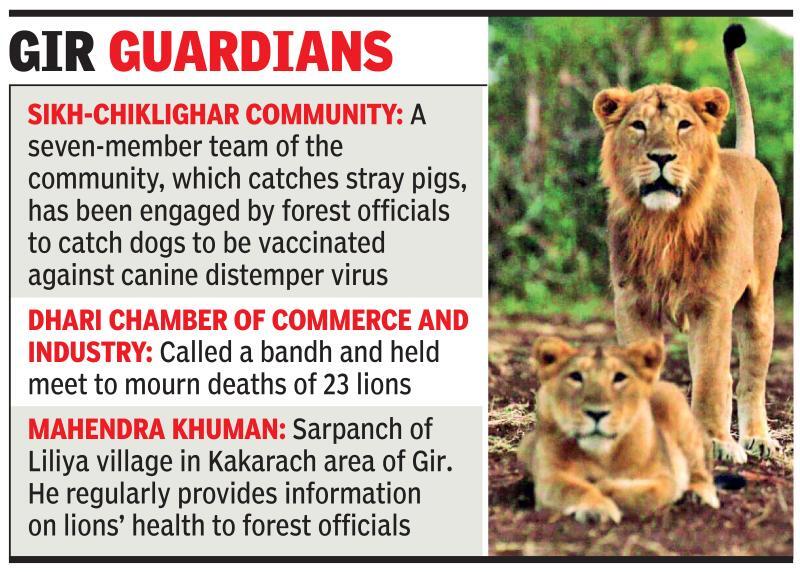
But for Babu Dhola, a trustee of Jab Gaushala in Gir, even an attrition of one is a horror. His passionate vigilance in monitoring the well-being of a pride living near his village had revealed something amiss. Subsequently, he was the one who set off the first alarm about a disease outbreak hitting the lions. “On September 10, one of my employees spotted a weak lioness. I then instructed all my employees to keep a watch on the 29-member pride, who were the first victims of the viral epidemic. We had accompanied forest officials in their rescue missions. However, we could save only three,” he says.

The bond that Gir villagers feel for the lions is exemplified by the sentiments of Lakha Gadhvi, the vice-president of the Gir Maldhari Samaj, a body of representatives from the pastoral communities here. “The lions rule this land and are its first inhabitants. They have rights over our cattle. They are part of our family and we exist because of them,” he says.

Gadhvi and hundreds of pastoralists had gathered in Visavadar for a ‘besna’ (mourning) organised in memory of the 23 dead lions. “More than half of our community members never claim compensation when their cattle are eaten by the lions. Our people are rarely attacked by the lions,” he says.

The crisis in Gir drove two medical practitioners, Purvesh Kacha and Jalpan Rupapara, 100km from their home turf of Amreli to Sasan, where they are assisting forest department staff in removing misconceptions among local residents about CDV and babesiosis. “In some villages, people feared that CDV will spread to them. We were apprehensive that social media rumours would harm conservation efforts and undertook a mass awareness drive,” Rupapara says.

Razak Baloch, founder of a non-governmental organisation (NGO) called Environment Protection Committee had apprised the range forest officers of a looming epidemic. Eventually, six lions died in quick succession at Sarasiya Virdi area. “We had first raised public awareness on the mysterious deaths of lions and then took to the street to put pressure on the forest department officials to act fast,” he says.
https://timesofindia.indiatimes.com/city/ahmedabad/girs-communities-close-ranks-to-battle-viral-epidemic-in-lions/articleshow/66229046.cms

Gujarat HC questions Centre over meagre funding for lions

| Updated: Oct 16, 2018, 05:28 IST

A bench of Chief Justice R S Reddy and Justice V M Pancholi directed the Centre to show its long-term plan for lion conservation.
AHMEDABAD: Gujarat high court on Monday asked the central government to explain the rationale behind giving the lion’s share to tigers and allocating meagre amounts for the Asiatic lions.
A bench of Chief Justice R S Reddy and Justice V M Pancholi directed the Centre to show its long-term plan for lion conservation and allocation of funds for the big cats — whether they have increased or decreased over the years.

During the hearing of a suo motu PIL filed by the HC on deaths of 182 lions in last two years, the court sought to know why the Centre’s funds are in thousands for a lion and in lakhs for a tiger. This was on basis of a report by amicus curiae Hemang Shah who cited a TOI report stating that the Centre had allocated Rs 95,000 for a lion, whereas it granted Rs 15 lakh for a tiger under Project Tiger.

On Monday, the amicus curie highlighted again the problems that plague Gir sanctuary for lion conservation. Advocate Shah stressed on quick resolution of issues like open wells, electrocution of lions and controlling speeds of vehicles on highways that pass through the forest areas. He submitted that over 17,000 wells have remained open and the government should be asked to place action taken report every two months for covering those wells. He reiterated the measures suggested in his report to stop electrocution deaths.To explain the measures taken to curb spread of the virus which caused lions’ deaths in last month, additional advocate general Prakash Jani told the HC about the vaccination plans. He submitted that the deaths occurred in a limited area of 150sq km out of 1,800 sq km belonging to Gir forest. To this, the judges said, “Vaccination of lions is a specialized subject and we are not subject expert. The opinions and suggestions of the experts need to be followed. We also read about a lion falling into a well yesterday and it is a very serious matter.”

The HC said that the lion conservation programme should be implemented in a time-bound manner. It also asked the state government to supply information on the building of parapets around open wells.

Meanwhile, in another PIL that opposes the proposed reduction of eco-sensitive zone
https://timesofindia.indiatimes.com/city/ahmedabad/gujarat-high-court-questions-centre-over-meagre-funding-for-lions/articleshow/66228899.cms

How Modi, Rupani want Gujarat to be exclusive abode of Asiatic lions

Economists are zoophobes, though they talk of animal spirits, as Manmohan Singh did while unleashing market reforms in 1992. Till the 1980s they knew only about bulls and bears; in the 1990s they learnt about Asian tigers, and then the Indian elephant.
They took note of the lion, which had been more deeply embedded in our cultural psyche than the bull, the bear, the tiger or the elephant, only after Narendra Modi began his reign with an MGM roar. Just like Asoka of Ahimsa got a lion capital on his Sarnath pole as the pillar of kingly dharma and Pax Mauryana, Modi got a greasy gear-and-spanner Gir lion as the mascot of his economic programme.
Modi has pretensions of being India’s Henry the Lion, the duke of Saxony who tamed lions and slew dragons. But the Congress thinks that in four years he has become like England’s Henry II, the Lion in Winter. Especially so, after his mane and name have been singed in the Rafale’s afterburner.
The full-maned Asiatic lions, which have been prospering and procreating in Gir, are owner’s pride and neighbour’s envy to Gujaratis. Their state looks like a lion-head on the map, though the jealous scoff at it as a Lion’s Club logo. The tiger may be the national animal, but Gujaratis are proud of being the exclusive hosts to the lion, the king of the jungle and by far a nobler beast.
Modi partakes of that pride. As chief minister he had resisted a Supreme Court order to shift a few of the Gir cats to Kuno-Palpur in Madhya Pradesh. The court was worried that if all the 600 stayed together on one turf, they would all be wiped out in a flood or a plague.
The fears seem to be coming true. The gamekeepers of Gir report that lions are dying at the rate of one a day due to protozoa infections and a canine distemper virus which had killed a third of East Africa’s lions a few years ago. This has caused a hue and cry for shifting a few cats to safer zones, but Chief Minister Vijay Rupani would hear none of that.
Illustration: Bhaskaran Illustration: Bhaskaran
Green dragons elsewhere may make a hue and cry, or a mew and roar, but for once Modi and Rupani are getting support from even Congressmen in Gujarat. Look at what arch foe Ahmed Patel has written to Modi—get more vets, build more lion dens and pull down tourist dens, enlarge Gir’s buffer by 10km, and launch a Project Tiger-like programme. Not a word about lending or sending a few cats to MP.
Not without reason. Project Tiger may have been a roaring success, but with 50 tiger parks spread across India, the tiger has become another cat in the touristy wilderness, phone-shot by every selfie-taking teenager.
On the contrary, the lion, distant yet dignified, has always kept his aristocratic exclusivity. He was coveted, much more than the tiger, in royal and noble iconographies across cultures. Asoka had his four lions on his dharmic pillar, free India got them as its coat of arms. Thrones were called sinhasans; martial Rajputs called themselves Singhs; and the warrior-Guru Gobind urged his men to be Singhs.
Europe never had a lion from the Urals to the English Channel and beyond, yet several European royal and noble heraldries had the lion on their coats of arms. The English called their crusader-king a Lionheart; their royal coat of arms has been sporting three lions since 900 years; and Lady Britannia has one crouching beside her. The Jews have their Lions of Judah, a concept as old as the Book of Genesis. Closer home, Singapore derives its name from the lion, as do the Sinhalas.
The tiger was feared; the lion was coveted and revered.
prasannan@theweek.in
https://www.theweek.in/columns/prasannan/2018/10/12/how-modi-rupani-want-gujarat-to-be-exclusive-abode-of-asiatic-lions.html