Monday, 06 August 2012 13:28
PNS | New Delhi
The home of the world’s last population of Asiatic lions in the
wild, Girnar Forests in Gujrat will now be surrounded by eco-sensitive
zone. The Ministry of Environment and Forest (MoEF) has also declared
the setting up of similar zones around the wildlife sanctuaries of Purna
in Dangs, Narayan Sarovar in Kutch and Vansda National Park in Valsad.
Mining, industrialisation and tourism activities here will also have to
be regulated.
As per the MoEF notification issued recently, Girnar eco-sensitive
zone will occupy an area of 9,318 hectares covering a span of five-km
radius around the sanctuary that covers 27 villages. The area will have
development that would henceforth be regulated through a zonal master
plan expected to come up within two years.
The eco-sensitive zone around the Purna wildlife sanctuary will have
an area of 25,036 ha covering a two-km radius, that also includes 61
villages. Purna has above 3,000 species of plants and animals..
The notification further states that the zone around Narayan Sarovar
wildlife sanctuary will occupy 22,588 ha, of which about 60% is
non-forest land. It will stretch up to 2.5 kilometers throughout the
sanctuary’s periphery, covering 28 villages.
The sources pointing to the specialty of Narayan Sarovar said it
falls under “a separate biotic province of the country” and thereby has a
distinct gene pool, that include grasslands in arid regions, mangrove
forests along the coastal stretches and wetlands.
Vansda National Park that once took pride in flaunting tigers today
takes pride in bird species that are typical to the Western Ghats are .
The area also abounds in various kinds of medicinal shrubs and herbs
with orchids, litchens and ferns.It also hosts nine mammalian species
and some rodent species, as well as reptiles and amphibians. The
eco-sensitive zone in the National Park will spread over five kms of its
total periphery and covering about 13 villages.
Source: http://dailypioneer.com/nation/85619-eco-sensitive-zones-to-now-shield-asiatic-lions-in-gujarat.html
Thursday, August 30, 2012


Bookings hit at Ranthambore over SC ban.
JAIPUR: It was a day of mixed fortunes for Rajasthan that has been advocating regulated tourism in tiger reserves rather than a complete ban.
The Supreme Court on Wednesday asked the Centre to formulate fresh guidelines for protection of tigers in core and buffer zones, providing room for an alternate route to be considered.
However, with the court deciding to continue the ban till the next hearing on September 27, just days before the Ranthambore tiger reserve opens to visitors on October 1, tourism at the park is sure to take a beating.
The online booking of Gypsies and canters for a safari at the park by the forest department is yet to begin. "Normally, online bookings start a month or two before the park opens for the season. However, this time with the Supreme Court ban, there is no way we can begin bookings. Else, tourists' money will get stuck," said AC Chaubey, chief wildlife warden, Rajasthan.
Till the last season, to get a Gypsy booked for a safari was a matter of luck as bookings are closed within the first week of the season owing to heavy rush of tourists.
Requests for cancellation of rooms at hotels too have started pouring in. Balendu Singh, president, Hotel Owners' Association in Ranthambhore said, "October November are major months for us. With festivals lined up, tourists head to Ranthambhore. This is not the case this year. Most people who are travelling on a holiday like to plan their tour well in advance but with the Supreme Court ban there is an uncertainty about visits to the park. The effect can be felt in the number of bookings."
With the court fixing the date of hearing in the case so close to the time when the park opens to public, hoteliers said fate of several bookings have been left to the last minute.
"First, we had told them (tourists) that by Wednesday the court would come up with a decision, but now with the ban being extended, we will have to intimate them once again through e-mails. We hope that the ban is eventually lifted. Ranthambhore has managed well with regulated tourism since several years and other states can learn from us. Even during peak season, just 40 vehicles are allowed to go inside the park everyday," he adds.
On the brighter side, with the Supreme Court in its fresh order asking stakeholders to make their submissions within a week to the committee set up for framing the guidelines for consideration, it is possible that many states, including Rajasthan, that have earlier sent their recommendations to the ministry will now approach the court straight away.
Rajasthan that has been leading a crusade of sorts gathering all tigers states in the country under an umbrella so that the total ban is lifted might just decide to represent its case on its own. However, officials refused to comment anything on the matter and said, "It is too early to decide on such things now."
Source: http://timesofindia.indiatimes.com/city/jaipur/Bookings-hit-at-Ranthambore-over-SC-ban/articleshow/15969295.cms
Wednesday, August 29, 2012
Population of Gyps vultures falls by 65% since ’05.
Express news service
Posted: Aug 29, 2012 at 0549 hrs IST
Ahmedabad
The population of critically endangered Gyps vultures
found in Gujarat continues to decline and has fallen by around 65 per
cent since 2005, the just-released results of this year’s state-wide
population survey suggests, noting a fall from 2,657 vultures then to
938 vultures now.
Posted: Aug 29, 2012 at 0549 hrs IST
But the decline has been less steep in the last two years and stands at about 11 per cent, although experts warn this may seem so partly because survey efforts have been strengthened and enumerators have been able to spot more of the winged scavengers.
“Apart from the apparent inaccuracies that may emerge from subsequent survey qualities, the latest survey estimates show the vulture population seems to be stabilising slowly, and that may be attributed to the fact that diclofenac use has gone down, people are more aware, and those are areas where we should concentrate on also. The vulture is also not a hated bird any more, and people are cutting down less trees that house them,” said Pradeep Khanna, Principal Chief Conservator of Forests (PCCF).
The International Union for Conservation of Nature (IUCN) blames the “anti-inflammatory veterinary drug diclofenac, used to treat domestic livestock” and which causes renal failure and visceral gout, and a “second veterinary drug, ketoprofen,” as major threats to the two Gyps vultures across India.
Gyps vultures are also known as Old World Vultures and are genetically distinct from what are called New World Vultures. A major difference between the two is that Gyps vultures exclusively depend on sight to locate food while their new world counterparts exhibit powerful olfactory senses.
In Gujarat, two kinds of Gyps vultures, the White-rumped vulture and the Long-billed vulture, are found.
Interestingly, while the population of White-rumped vultures has decreased by 27 per cent since 2010 and is currently estimated at 577 individuals, the population of Long-billed vultures has grown by 36 per cent in the same period and is estimated at 361 individuals currently.
For the first time, this year’s survey also enumerated non-Gyps vulture species found in the state, including the endangered Egyptian Vulture and the the critically endangered Red-headed (King) Vulture, finding 97 and 8 individuals of each respectively.
Kutch (with 180 White-rumped vultures), Junagadh (with 26 White-rumped vultures, 122 Long-billed vultures and 5 Red-headed vultures) and Bhavnagar (with 99 White-rumped vultures and 3 long-billed vultures) are the three districts with the highest number of vulture populations in the state. While 17 districts host vulture populations, nine districts have none.
The 2012 survey was conducted over two days in May. Besides the state Forest Department’s front-line staff, employees of the Gujarat Ecological Education and Research (GEER) Foundation, about 225 volunteers (naturalists, nature lovers and birders) were also involved.
Source: http://www.expressindia.com/latest-news/population-of-gyps-vultures-falls-by-65-since-05/994719/
Tuesday, August 28, 2012
IT'S A JUNGLE OUT THERE .
Tuesday August 28 2012 by Adrian LeeTHE genteel
surroundings of Clacton-on-Sea are about as far removed from the usual
habitat of a lion as can be imagined. So it was only natural that
reports that the King of the Jungle had somehow found his way to the
Essex coast caused a stir.
A hunt for the beast involving marksmen and
helicopters was launched and people were warned to stay indoors before
the search was called off yesterday leaving a mystery.
However, we shouldn’t be surprised that the authorities gave it their full attention.
Defra,
the government department responsible for the countryside, does not
accept that big cats and other exotic wild beasts roam freely in
Britain.
Yet there’s
compelling evidence to the contrary. From the desolate Highlands of
Scotland to the busy streets of London, wild animals normally associated
with the other side of the world have apparently been seen in almost
every nook and cranny of the nation. In the past decade there have been
more than 6,000 sightings, including 190 this year alone.
Mark
Fraser, founder of Big Cats in Britain, says: “The vast majority of
sightings are a case of mistaken identity but I have little doubt there
are big cats out there. They don’t survive in large numbers but big cats
are very adaptable and the climate in Britain is perfect.
 There’s also a plentiful food supply. A big cat can survive on one deer, or two rabbits, a week There’s also a plentiful food supply. A big cat can survive on one deer, or two rabbits, a week
|
|
Mark Fraser, founder of Big Cats in Britain
|
“There’s also a plentiful food supply. A big cat can survive on one deer, or two rabbits, a week.”
Big
Cats in Britain takes its responsibilities seriously and, in addition
to volunteers all over the UK, has DNA testing facilities and trackers
ready to spring into action the moment there’s a quality sighting. It’s
also inundated with carcasses and droppings, sent by members of the
public who are intent on solving the riddle of Britain’s wild beasts.
The
animals most likely to thrive in the UK are black leopards, jaguars
and sandy-coloured pumas, which are also known as mountain lions.
Lynx,
which were supposedly hunted out of existence in medieval times, could
also be roaming wild. There have been calls to re-introduce the animals
officially, to control the deer population, along with wolves, which
died out in the 1700s. Wild boar, hunted in ancient times by kings,
could also be poised for a revival.
Down the years there have been some famous encounters. The most notorious big cat is the Beast of Bodmin, which has been seen regularly since the Eighties. Sightings in this area of Cornwall, along with the discoveries of animal carcasses bearing fang-like marks, have prompted claims of a colony of panther-like wild cats.
The Beast of
Bodmin’s infamy reached a peak in 1983 when a Devon farmer reported 100
sheep killed. The Government mobilised a team of crack snipers from the
Royal Marines but all that was found at the time was a fox.
When
a 14-year-old boy came across a skull in the River Fowey it seemed
proof had finally been unearthed. However, experts at London’s Natural
History Museum concluded it was from a panther that had been killed
overseas and dropped on the moor.
That
hasn’t stopped amateur trackers descending on the area and there is a
20-second video showing a black, three-and-a-half foot animal roaming
the region.
Sceptics say that even if these beasts do exist the chances of the same species meeting and mating is highly unlikely.
In
addition to fearsome animals, species such as racoons, wallabies,
scorpions and a penguin are also on the loose, says a report by animal
group Beastwatch UK.
Big cat hunters have also targeted Carmarthenshire, in South Wales, following a spate of attacks on sheep.
In Wales in August 2000, an 11-year old boy was attacked near his home in Monmouthshire.
Josh
Hopkins from Trellech, needed medical treatment after he was left with
five claw marks across his face. Experts thought a juvenile leopard
might have been the culprit.
In
1994 a beast known as “the fen tiger” was captured on video in
Cambridgeshire and sightings from this area continued up until 2008.
In
October 1980, a female puma was captured at Cannich in Inverness-shire.
The big cat had been spotted in the area for up to two years before a
farmer built a metal cage trap and placed it on part of his land where
the animal was known to roam.
The
captive puma was taken to Kincraig Wildlife Park near Kingussie and
lived for another five years. Christened Felicity, she was stuffed after
her death and can now be seen at Inverness Museum.
The
animal, which was remarkably tame, had almost certainly been released
into the wild by a private collector not long before the initial
sightings. Intriguingly, Felicity’s capture did not end the sightings
and the wide expanse of the Highlands would seem to be ideal territory
for such beasts to roam freely.
More surprising was the case of Lara the Lynx, a big cat captured in Golders Green, North London, in May 2001.
London
Zoo’s head keeper of big cats Ray Charter, who answered a call from a
member of the public, said at the time: “We get numerous calls reporting
big cat sightings and so far nearly all of them have proved incorrect.
It usually turns out to be a large domestic cat.
“You
can imagine my surprise when I bent down to look under the hedge
expecting to see a large ginger Tom, only to be met by a much more
exotic face.”
The animal
evaded capture with a net but was eventually sedated with a dart from a
blowpipe. Lara’s origins are unknown but she was last heard of living
happily in a zoo in France where she was part of a breeding programme.
Another
lynx was shot after attacking sheep near Norwich in 1991. Two years
later a leopard suffered the same fate on the Isle of Wight after
feasting on poultry.
Yorkshire is the area of Britain which produces the most sightings but reports come in from all over the UK.
So
far this year there have been 190 reports of wild animals on the loose
following more than 500 in 2011. This year’s crop includes the case of
two terrified joggers who claim to have been confronted by a big black
cat in the Lake District in February. There have been many similar
reports of a large black beast in the same area.
Also
this year, the discovery of a series of savaged deer corpses fuelled
fears that a big cat was on the prowl in Gloucestershire. The county’s
Forest of Dean is another renowned hot spot but these beasts are
incredibly elusive. Mark Fraser of Big Cats in Britain has been keeping
an eye out for them for 25 years but has sighted only three.
His
most exciting encounter was in 2004, near Hemingby in Lincolnshire,
where DNA tests on a hair recovered from an old caravan, confirmed the
existence of a black leopard.
He
says: “I was following up reports of a sighting of a black cat and saw
it run across a field. I have no doubt it was a leopard. It’s been seen
several times since.”
Putting
a figure on the precise number of big cats on the loose at any one time
is impossible. A single puma can roam across territory covering 160
square miles so the same beast is likely to generate multiple sightings.
The lifespan of a big cat in the wild is about 12 years. It’s likely
that most sightings are of animals that have escaped from zoos or been
illegally released by private collectors.
Since
1976 it’s been illegal to own any of the big cats without a licence.
Before then it was fashionable for the rich and famous to have exotic
pets such as panthers and pumas, which were decked out in tacky,
glittery collars and paraded around the streets.
It was expected that tightening the law would result in a slump in sightings but that’s not been the case.
Fraser
says: “For some people, owing a wild cat is still a status symbol.
Throughout the world the illegal trade of these animals is second only
to drug dealing.”
The Holy Grail for organisations which track and monitor these elusive beasts is to prove the existence of breeding colonies.
Fraser adds: “There have been reliable reports of mothers and cubs but no concrete evidence.”
Reassuringly,
the chances of anyone coming unexpectedly face-to-face with a big cat
are remote. They are shy animals, which hunt at night and shun open
spaces but the expert warns: “If you happen to corner one it will go for
you. They are dangerous wild animals and deserve our respect.
“A
big cat can easily kill a human, although the reality is it will be
aware of you before you get anywhere near and probably be long gone.”
Unlike the life-size toy tiger which sparked a major operation when it
was left lying in a field near Southampton last year.
Source: http://www.express.co.uk/posts/view/342457/It-s-a-jungle-out-there
Source: http://www.express.co.uk/posts/view/342457/It-s-a-jungle-out-there
Lions pressured by fodder shortage.
AHMEDABAD: Gujarat foresters are dealing with a new threat to the Gir
wildlife sanctuary. Scarcity of fodder on the periphery of the sanctuary
is forcing politicians to pressure the forest department to permit
Maldharis to bring their cattle inside the sanctuary for grazing.
Forest officials said that MLAs from the ruling party were trying to ensure that the Maldhari community around the sanctuary was allowed into Gir, Girnar, and Mitiyala sanctuaries. Sources said the pressure was constant.
This being an election year, officers are in a fix as members of the two main political parties want local inhabitants to illegally enter the area.
Bhagvan Bharwad, the MLA from Talala, said: "We will wait till Sunday and if there is no rain, we will make representations to the state government and even write to chief minister to permit grazing in the forest." Bharwad said grass was not available and one could not let animals die for want of food. "If the forest department or the state government refuses to give us permission, we will enter the forest without permission," he said. "Let them take action."
A forest official said that in the recent past, a couple of attempts were made to enter the forest but guards prevented people from venturing deep into the sanctuary.
The sanctuary is closed for public for four months during monsoon, from June 15. Forest officials said that during this period the danger of lion attack was high. If Maldharis were permitted to enter the forest with cattle, risk to their lives would be immense.
Forest officials said that Maldharis were illegally allowing their cattle to graze in areas near the boundary of the sanctuary. "This is the peak season for breeding for not just the big cats, but even for the herbivores," a forest official said. "The newborn of the herbivores learn to walk. At such a time, if cattle is permitted to graze in the sanctuary, they could be a nuisance to the newborn."
Source: http://timesofindia.indiatimes.com/city/ahmedabad/Lions-pressured-by-fodder-shortage/articleshow/15859327.cms
Forest officials said that MLAs from the ruling party were trying to ensure that the Maldhari community around the sanctuary was allowed into Gir, Girnar, and Mitiyala sanctuaries. Sources said the pressure was constant.
This being an election year, officers are in a fix as members of the two main political parties want local inhabitants to illegally enter the area.
Bhagvan Bharwad, the MLA from Talala, said: "We will wait till Sunday and if there is no rain, we will make representations to the state government and even write to chief minister to permit grazing in the forest." Bharwad said grass was not available and one could not let animals die for want of food. "If the forest department or the state government refuses to give us permission, we will enter the forest without permission," he said. "Let them take action."
A forest official said that in the recent past, a couple of attempts were made to enter the forest but guards prevented people from venturing deep into the sanctuary.
The sanctuary is closed for public for four months during monsoon, from June 15. Forest officials said that during this period the danger of lion attack was high. If Maldharis were permitted to enter the forest with cattle, risk to their lives would be immense.
Forest officials said that Maldharis were illegally allowing their cattle to graze in areas near the boundary of the sanctuary. "This is the peak season for breeding for not just the big cats, but even for the herbivores," a forest official said. "The newborn of the herbivores learn to walk. At such a time, if cattle is permitted to graze in the sanctuary, they could be a nuisance to the newborn."
Source: http://timesofindia.indiatimes.com/city/ahmedabad/Lions-pressured-by-fodder-shortage/articleshow/15859327.cms
Why rare Asiatic lions stray out of Gir forest.
Last updated on: August 27, 2012 09:54 IST
Image: The map of Gir national park and sanctuary in Gujarat
Photographs: Courtesy: Wikimedia Commons Of course, it could be dangerous to have more lions living in smaller areas like these. According to medical experts, the population of Gir lions is inbreeding and hence their cubs have little resistance power against certain diseases.
More than 150 lions are reported to have died in Gir in the last five years and at least 50 per cent of them were cubs.
Concerned wildlife activists warn that if a certain number of Gir lions are not shifted somewhere else, they will continue to die untimely deaths at regular intervals.
Gir has long reached a saturation point. The forest has already been very dense in many parts.
"The density of Gir has touched an alarming figure of almost 80 per cent. Lions in particular find it difficult to live comfortably in the dense forests. They do not get their prey on time. Something must be done to lessen the density of Gir," says a wildlife expert.
 But it is
not easy. The lions can always feel at home in the grassland. But you
cannot cut teak plantation to reduce the density of the forest because
of the environment law.
But it is
not easy. The lions can always feel at home in the grassland. But you
cannot cut teak plantation to reduce the density of the forest because
of the environment law.
"The trouble is that if you try to solve one problem, you face two new ones! But something must be done by all concerned to conserve the rare Asiatic lions," adds another nature and wildlife lover.
Haresh Pandya tries to find out what ails the rare Asiatic
lions of Saurashtra's Gir forest and why they stray out of their only
habitat in the world.
While there has been a steady increase in the population of the rare Asiatic lions in the dense forests of Gir in the Saurashtra peninsula of Gujarat in the last fifteen years, there have also been many incidents of their untimely deaths, including by poachers until recently for their priceless claws and teeth.
Officially there were 309 lions in 1995, 321 in 2001 and 359 in 2005. In the last census, conducted in 2011, there were 526 lions in Gir forests.
 This may not be a big
figure, but considering the fact that Gir is spread in an area of only
1,412 sq km, it is an enormous number.
This may not be a big
figure, but considering the fact that Gir is spread in an area of only
1,412 sq km, it is an enormous number.
Usually a single adult lion requires grassland of about, say, 25 sq km to live and roam comfortably. Wildlife experts familiar with the geography of Gir believe its forests cannot provide shelter to more than 200 lions, all factors considered. (And one is not even talking about other big cats, particularly leopards, which are already there in a larger number to accompany the lions.)
Image: A rare Asiatic lion from Gir forest yawns at a zoological park in JunagadhWhile there has been a steady increase in the population of the rare Asiatic lions in the dense forests of Gir in the Saurashtra peninsula of Gujarat in the last fifteen years, there have also been many incidents of their untimely deaths, including by poachers until recently for their priceless claws and teeth.
Officially there were 309 lions in 1995, 321 in 2001 and 359 in 2005. In the last census, conducted in 2011, there were 526 lions in Gir forests.
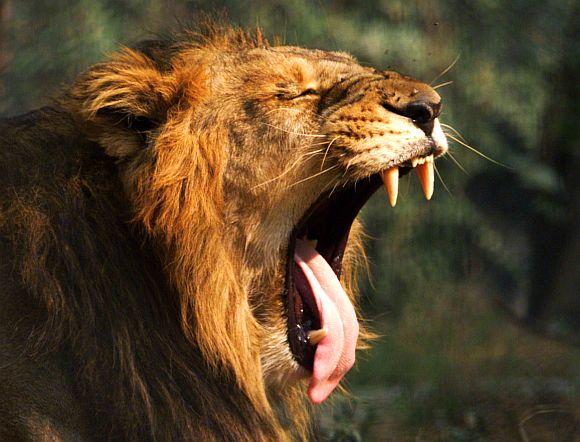
Usually a single adult lion requires grassland of about, say, 25 sq km to live and roam comfortably. Wildlife experts familiar with the geography of Gir believe its forests cannot provide shelter to more than 200 lions, all factors considered. (And one is not even talking about other big cats, particularly leopards, which are already there in a larger number to accompany the lions.)
Consequently they tend to step out of what
is their only habitat in the world and explore hamlets and villages on
the periphery of Gir in search of preys, much to the chagrin of their
inhabitants, who are concerned not only about their own lives but also
their livestock, and to the delight of poachers.
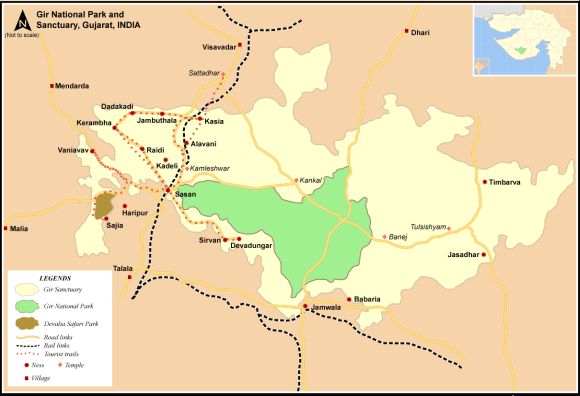
As if that was not enough, there is an alarming increase in encroachment in the very heart of Gir. There are at least four major temples in Gir, of which Kankai and Tulshishyam are very famous and remain crowded with hundreds of pilgrims throughout the year, except during the monsoon.
Add to these a railway line and a couple of roads on which government and private vehicles regularly ply and the plight of the Gir wildlife is complete. One can only feel sorry for the lions and other animals.
 Incidents
of a lion or two, or even a pride for that matter, straying out of
their protected areas and attacking and killing domesticated animals of
farmers, shepherds, milkmen and other settlers living on the outskirts
of Gir are neither uncommon nor infrequent. (Of late they have started
fatally attacking even humans sleeping outside their homes in the dead
of night.)
Incidents
of a lion or two, or even a pride for that matter, straying out of
their protected areas and attacking and killing domesticated animals of
farmers, shepherds, milkmen and other settlers living on the outskirts
of Gir are neither uncommon nor infrequent. (Of late they have started
fatally attacking even humans sleeping outside their homes in the dead
of night.)
In fact, at times the Gir lion is sighted even on the coastal areas of Una, Seemar, Kodinar, Sutrapada, Veraval, and even the stunningly picturesque island of Diu, which is a favourite destination of many a tourist.
Image: An Asiatic lion rests in Gir forest in GujaratAs if that was not enough, there is an alarming increase in encroachment in the very heart of Gir. There are at least four major temples in Gir, of which Kankai and Tulshishyam are very famous and remain crowded with hundreds of pilgrims throughout the year, except during the monsoon.
Add to these a railway line and a couple of roads on which government and private vehicles regularly ply and the plight of the Gir wildlife is complete. One can only feel sorry for the lions and other animals.
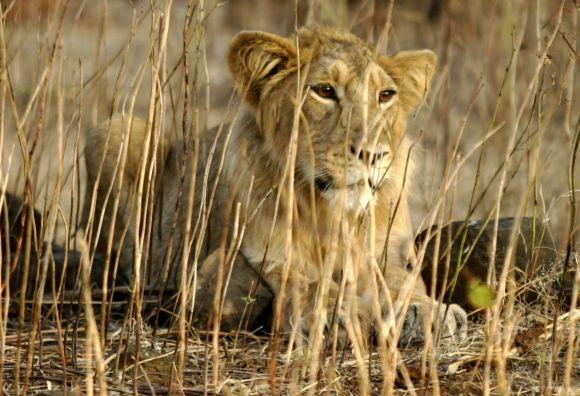 Incidents
of a lion or two, or even a pride for that matter, straying out of
their protected areas and attacking and killing domesticated animals of
farmers, shepherds, milkmen and other settlers living on the outskirts
of Gir are neither uncommon nor infrequent. (Of late they have started
fatally attacking even humans sleeping outside their homes in the dead
of night.)
Incidents
of a lion or two, or even a pride for that matter, straying out of
their protected areas and attacking and killing domesticated animals of
farmers, shepherds, milkmen and other settlers living on the outskirts
of Gir are neither uncommon nor infrequent. (Of late they have started
fatally attacking even humans sleeping outside their homes in the dead
of night.) In fact, at times the Gir lion is sighted even on the coastal areas of Una, Seemar, Kodinar, Sutrapada, Veraval, and even the stunningly picturesque island of Diu, which is a favourite destination of many a tourist.
There has been a move by the government of India for translocation of a specific number of lions from Gujarat to Madhya Pradesh.
But the Gujarat government has strongly and persistently opposed any such move, arguing that when Madhya Pradesh is unable to protect its tigers, what is the guarantee that the lions will be safer there. It is also argued that lions and tigers cannot live together.
On the other hand, Madhya Pradesh government says that it is very risky to keep the entire lot of lions at one particular place; arguing that any epidemic or natural or man-made calamity may wipe out the entire population of the already rare Asiatic lions.
A long legal battle has been going on between Gujarat and Madhya Pradesh governments in the Supreme Court for many years over this issue.
There was an "outer" Gir within Gujarat almost a hundred years ago, covering, among other areas, the forests on the Barda hills near Porbandar.
There were lions on Barda in the past. But today the forest area of Barda is spread across only 192 sq km.
Another problem is there is nothing for the lion to hunt for its prey on Barda, not even species of the deer. To develop all this, and much more besides, is a Himalayan task.
However, the Gujarat government has already started lion breeding centres in Barda as well as at Rampara near Rajkot and Jesar near Bhavnagar.
 Source: http://www.rediff.com/news/slide-show/slide-show-1-must-read-why-rare-asiatic-lions-stray-out-of-gir/20120827.htm
The idea is to develop these small forest areas of Saurashtra as second homes of sorts for a select few lions and reduce the "burden" on an already congested Gir.
Some wildlife experts are also in favour of shifting several lions from Gir to Hingolgadh hills in Rajkot district.
But the Gujarat government has strongly and persistently opposed any such move, arguing that when Madhya Pradesh is unable to protect its tigers, what is the guarantee that the lions will be safer there. It is also argued that lions and tigers cannot live together.
On the other hand, Madhya Pradesh government says that it is very risky to keep the entire lot of lions at one particular place; arguing that any epidemic or natural or man-made calamity may wipe out the entire population of the already rare Asiatic lions.
A long legal battle has been going on between Gujarat and Madhya Pradesh governments in the Supreme Court for many years over this issue.
There was an "outer" Gir within Gujarat almost a hundred years ago, covering, among other areas, the forests on the Barda hills near Porbandar.
There were lions on Barda in the past. But today the forest area of Barda is spread across only 192 sq km.
Another problem is there is nothing for the lion to hunt for its prey on Barda, not even species of the deer. To develop all this, and much more besides, is a Himalayan task.
However, the Gujarat government has already started lion breeding centres in Barda as well as at Rampara near Rajkot and Jesar near Bhavnagar.
 Source: http://www.rediff.com/news/slide-show/slide-show-1-must-read-why-rare-asiatic-lions-stray-out-of-gir/20120827.htm
The idea is to develop these small forest areas of Saurashtra as second homes of sorts for a select few lions and reduce the "burden" on an already congested Gir.
Some wildlife experts are also in favour of shifting several lions from Gir to Hingolgadh hills in Rajkot district.
Image: The map of Gir national park and sanctuary in Gujarat
Photographs: Courtesy: Wikimedia Commons Of course, it could be dangerous to have more lions living in smaller areas like these. According to medical experts, the population of Gir lions is inbreeding and hence their cubs have little resistance power against certain diseases.
More than 150 lions are reported to have died in Gir in the last five years and at least 50 per cent of them were cubs.
Concerned wildlife activists warn that if a certain number of Gir lions are not shifted somewhere else, they will continue to die untimely deaths at regular intervals.
Gir has long reached a saturation point. The forest has already been very dense in many parts.
"The density of Gir has touched an alarming figure of almost 80 per cent. Lions in particular find it difficult to live comfortably in the dense forests. They do not get their prey on time. Something must be done to lessen the density of Gir," says a wildlife expert.
 But it is
not easy. The lions can always feel at home in the grassland. But you
cannot cut teak plantation to reduce the density of the forest because
of the environment law.
But it is
not easy. The lions can always feel at home in the grassland. But you
cannot cut teak plantation to reduce the density of the forest because
of the environment law. "The trouble is that if you try to solve one problem, you face two new ones! But something must be done by all concerned to conserve the rare Asiatic lions," adds another nature and wildlife lover.
Image: Two-week old lion cubs from Gir forests snuggle together at a zoo in Bangalore
Photographs: Reuters
Source: http://www.rediff.com/news/slide-show/slide-show-1-must-read-why-rare-asiatic-lions-stray-out-of-gir/20120827.htm
Monday, August 27, 2012
Activists want illegal lion shows banned.
RAJKOT: Illegal lion shows near Khambha in Amreli district has worried wildlife activists.
On Saturday night, Jilu Bhukal, a Khambha resident was passing through Piplva on Chaturi road at around 12:30 am when he got suspicious on spotting some people by the roadside.
"When I inquired, a person told me he that he is from the forest department and started abusing me. I am a member of the cow protection committee and I got a tip-off about cattle being taken to slaughter house and I went for patrolling on that road. After a scuffle with the person, I immediately filed an application with Khambha police and informed the forest department. I suspect that there was lion show going on,'' Bhukal alleged.
According to Bhagu Soni, wildlife activist from Khambha, illegal lion shows have become common now.
"Within few minutes, people from Rajula, Dhari and Savarkundla reached the village when they heard about the lion's kill,'' he said.
"We got information that on Saturday night, more than 200 people from different villages visited the place where a lion killed a cattle and was eating it,'' Soni said.
Explaining the modus operandi, Soni said when a lion kills any cattle, the show organizers snatch the prey and drag it to some topographically higher places from where they can safely watch the lion eating its kill.
"This is absolutely illegal practice and it should stopped as it harasses lions,'' Soni said.
Soni said that in some cases, dead cattle were being dragged using tractors to organize such lion shows for fun.
"We are getting regular complaints from villages. In the time of scarcity, people have abandoned their cattle in large numbers. These cattle are tied to trees near a lion's territory and people wait for the lion to come and devour it. We have informed the forest department about this in the past too,'' said Himanshu Bhatt, another wildlife lover from Savarkundla.
However, when contacted, Tulsishyam range forest officer NB Pardva denied that lion shows were being held in his area. "All accusations about lion shows near Khambha are false. As far as Saturday night's incident, I have received the application from Jilubhai Bhukal and we will investigate this matter," Pardva said
Source: http://timesofindia.indiatimes.com/city/rajkot/Activists-want-illegal-lion-shows-banned/articleshow/15774010.cms
Sunday, August 26, 2012
MP plays Serengeti card to root for lions at Kuno.
NEW DELHI: Countering Gujarat's opposition to lion translocation project, the Madhya Pradesh government told the Supreme Court that a second habitat for Asiatic Lions in Kuno — cleared by National Board of Wildlife — was mandatory to avoid Tanzania's disastrous experience in Serengeti where outbreak of an epidemic almost wiped out the lion population.
Madhya Pradesh met with disdain Gujarat's apprehension about safety of lions. The Shivraj Singh Chouhan government did not deny the past lapses allowing poachers to wipe out entire tiger population in Panna, but said the new model of wildlife protection had got it laurels from many quarters and its efforts being replicated by other states.
"The efforts of the state have been duly recognized by Tiger Authority of India, which assessed the performance of the state of MP as outstanding," she said.
MP said Asiatic Lions continued to be in the Red List of International Union for Conservation of Nature (IUCN) and hence, "must be relocated and reintroduced in an area which would be suitable alternative habitat for its survival in the event of outbreak of any epidemic".
On the suitability of Kuno Palpur Sanctuary, MP said it was the historical range of Asiatic Lion, though the modern habitat was limited to Gujarat's Gir forests. To avoid any disease posing grave threat to lions concentrated in one location, there was consensus among experts and scientists for setting up of a second free-ranging population of Asiatic Lions, it said.
MP said effort to establish second home for Asiatic Lions was first made in 1957 by examining the suitability of Chandraprabha Sanctuary in Uttar Pradesh, but later in 2008, the National Board of Wildlife on February 18, 2008, unanimously recommended translocation of lions from Gujarat to Kuno Palpur, which was reiterated in December, 2009.
"With the highest technical body National Board for Wildlife taking a decision and confirming it after a review, the parties/stakeholders are required to implement the same and in the event of their non-implementation, it is open for the Supreme Court to direct the same," it said.
Gujarat had also objected translocation of lions to Kuno Palpur on the ground that the state was planning to reintroduce cheetahs there and that the cats could not co-exist.
MP said, "As far as introduction of cheetah is concerned, the said project is in its initial stage and is yet to be panned out. In view of the stay order passed by the Supreme Court on May 8, it is clear that presently the project of introduction of cheetah is not to be implemented, and thus, the said objection (of Gujarat) is infructuous."
Source: http://articles.timesofindia.indiatimes.com/2012-08-23/flora-fauna/33341355_1_kuno-palpur-asiatic-lions-gujarat-s-gir
Subscribe to:
Posts (Atom)